|
|
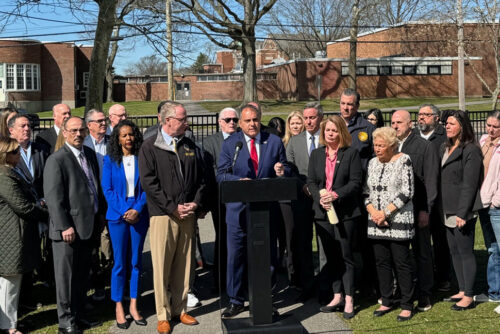
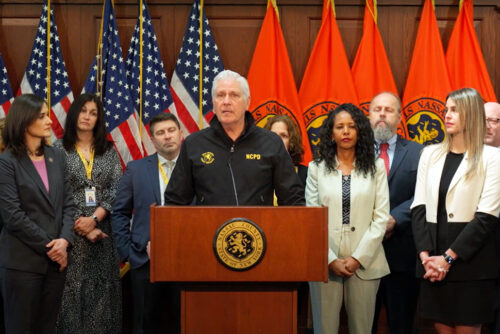
At a press conference held in front of the Garden City Post Office April 15, the day New York State and federal income taxes were due, Hempstead Town Supervisor Kate Murray voiced strong opposition to County Assessor Harvey Levinson's proposal to implement a Nassau County income tax.
|
Hempstead Town Supervisor Kate Murray publicly slammed County Assessor Harvey Levinson's proposal to create a modest county income tax at a press conference in front of the Garden City Post Office April 15, deadline day for filing tax returns. She described the assessor's idea as a "recipe for fiscal chaos."
"Today people are lining up at post offices around the country to pay federal and state income taxes," she said. "If the county tax assessor has his wish, Nassau residents will be lining up on April 15 next year to pay federal, state and county income taxes. Does Nassau County really want the dubious distinction of being the only county in the state to have a local income tax?"
Levinson, to Supervisor Murray's surprise, showed up at the press conference. He rebutted the supervisor's accusations, stating that he is not proposing a Nassau County income tax but rather proposing that a state-commissioned committee study the feasibility of eliminating the residential school property tax and replacing it with a modest income tax. "This press conference is just another attempt by a desperate candidate who sees me as a potential opponent and a threat to the status quo that has existed in the Town of Hempstead for too long," Levinson said. "This news conference would presume that we're going to have an income tax for schools and a property tax. That's not true. I would never support it unless we totally ended the school property tax."
Back in October 2004, Levinson proposed to completely eliminate the school property tax and replace it with a county income tax, which would be paid for by both owners and renters. "The rates are going to be so low," he boasted. "For the first $25,000 of income, subject to review, the rate would probably be one-half of 1 percent. It would be a very small amount. At the top end, maybe people who earned over $300,000 to $350,000 might have a 4 percent rate. But, by and large, I suggest the rate will be between 2 to 3 percent for most people in the county, progressively reaching 3 percent."
He also proposed the creation of a single commercial property school tax rate for all districts; tax monies collected would be redistributed to all school districts under a revenue sharing formula. He noted that Roosevelt Field Mall in Garden City pays more than $16 million in school taxes yet only two school districts share the revenue - Uniondale and, to a small degree, Garden City.
"Right now, if you're in a district like Herricks, you have little commercial property. If you're in a district like North Merrick you have very little commercial property. I think this is unfair. I think Roosevelt Field's taxes should be shared by all school districts," Levinson said.
He believes his proposal could provide several benefits, including a reduced tax rate for low-income families as well as a maximum taxable earnings cap, which would be created so that each homeowner and renter would pay their fair share of school income taxes. In other words, commercial property owners, owners of apartment buildings and non-residential property owners would continue to pay school taxes - but at a fairer and more uniform tax rate, Levinson said.
Another benefit to getting rid of the school property tax, according to Levinson, is the money residents will save when choosing to make improvements to their home. "When you put a dormer on your house, for example, that would no longer increase your school property taxes. The bottom line, almost everybody would benefit from this plan," he said.
Murray believes the assessor's proposal provides no positives for Nassau. She said the idea would increase the oppressive burden faced by taxpayers and adversely affect individuals and businesses alike. "An income tax would make Nassau less competitive with other suburban areas - whose residents' income is not taxed - and would drive jobs out of our communities," Murray said. "It would also strip homeowners of important property tax exemptions. Senior Citizen, STAR and Enhanced STAR exemptions would all be affected. Ultimately, homeowners would flee Nassau for neighboring suburbs."
Levinson said the supervisor misinterpreted his plan. "If the income tax becomes a reality, there is no necessity for the STAR program because the STAR program is a credit to help you pay your school property taxes," Levinson explained. The assessor further noted that money the government appropriates to STAR could then be added to state aid to offset districts that may need additional support.
The supervisor vowed she'd vigorously fight any proposal to "foist another level of taxation upon local residents." Levinson blames, in part, higher school taxes, on the Town of Hempstead's failure to enforce its zoning and building laws, which have resulted, he said, in a proliferation of illegal and unsafe multi-family apartments.
"If the Hempstead Town supervisor is truly interested in helping the hardworking taxpayers in Nassau, she should join with me in my call that Governor Pataki form a non-partisan, statewide committee to study the school property tax issue and the nearly 1,600 widely different tax rates that are imposed by some 400 taxing jurisdictions," Levinson said.
Admitting he does not have a monopoly on good ideas, Levinson said he welcomes a better idea to lessen the burden in Nassau. "I'm waiting for other elected officials to join me in saying, 'let's study it.' I don't have all the answers but I have a concept and I'd like it to be reviewed ... The status quo is simply unacceptable. People are leaving the county."
Levinson's proposal cannot be imposed without state authorization. Supervisor Murray has written state legislators who represent the Town of Hempstead, urging them to oppose the assessor's proposal.