By Carisa Keane
Fourteen environmental, business, planning, transit and community advocate groups, dubbed the Coalition for the LIRR Third Track, announced its formation at the Mineola train station May 26. The group, over the next year, hopes to push along the Long Island Rail Road's (LIRR) approximate $300 million Main Line Corridor Improvement Project, which seeks to construct another track on the Main Line from Bellerose to Hicksville, improve roadway crossings and make other improvements to the corridor.
|
|
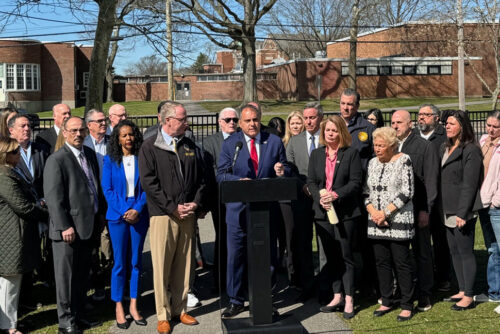
The Coalition for the LIRR Third Track announced its formation Wednesday, May 26, at the Mineola train station. Jon Orcutt, executive director of the Tri-State Transportation Campaign, which organized the coalition, speaks to reporters during a press conference. Photo by Carisa Keane
|
The additional capacity the project could provide would, among many things, enable more freight train use of the LIRR network, a bone of contention for many communities, particularly Garden City.
Back in 2001, Governor George Pataki assured Garden City that the Hempstead branch would be permanently closed off to freight traffic, the result of the Metropolitan Transit Authority (MTA), the LIRR and the New York & Atlantic Railway (NYA) finally reaching an agreement.
Residents living along the tracks that run parallel to Merillon however were particularly upset about the agreement since that station stops in Hicksville. "All of a sudden they state there'll be no more freight in Garden City. What about the residents who live a few houses from the Hicksville line?" one resident asked.
Jon Orcutt, executive director of the Tri-State Transportation Campaign, which organized the coalition, said further growth on Long Island would only demand more efficient transportation. "As we speak the MTA [Metropolitan Transportation Authority] is working on its 2005-2009 capital program," he said. "The coalition's purpose is to make sure adequate funding to get this project in the ground is included in this program."
A draft of the MTA's capital program is expected this July. Jeff Zupan, a transportation consultant, noted the MTA's capital needs at large are enormous. "There's going to be a battle for the priorities. It's unfortunate that that battle is taking place because the needs are much greater." Zupan suggested finding new resources of revenues to support the range of projects needed in the metropolitan region, adding, "The more revenues we find for the transportation lifeblood, mainly the transit system, the better and the more likely it is that the third track project can proceed."
The Long Island Association believes the LIRR Main Line Corridor Improvement Project is the most important transportation project solely on Long Island. Mitchell Pally, vice president of government affairs for the association, noted, "For all these years, we have always complained about mass transit and rail options not being available. This project can provide those opportunities for our commuters, residents and will finally allow the LIRR to be the LIRR and do what it was intended to do."
Eric Alexander, director of Vision Long Island, said the smart growth planning organization spent the last seven years listening to Long Islanders in approximately 600 meetings. "In all of those meetings, one of the biggest issues was traffic congestion," he said. "Long Islanders would constantly say that the LIRR doesn't have enough service..." Alexander believes the third track is a key issue and a key solution to Long Island's transportation issues. "When we talk about Long Island's build out over the next 10 to 15 years, this is a critical solution to improve our quality of life," he added.
Kathy Auro, who's lived on Merillon Avenue for 33 years, said the noise, even without a third track, has steadily increased over the years. "My neighbor and I can't stand this close to each other and have a conversation when the trains come barreling by," she said during an Environmental Advisory Board (EAB) meeting May 26.
Fellow resident John Donachie noted that a federal law to regulate train horn noise is going into effect in mid-December. "There's a 110 decibel noise level requirement on trains, considerably higher that that of airplanes [75 decibels]," he said. "I happen to live on Sixth Street and very close to the train tracks. You can't believe some of the shenanigans some of these guys on the train pull.
"If we start complaining about noise levels on the Main Line, maybe we could start to build a portfolio of complaints and lay some groundwork," he said. Some suggested speaking with local politicians Assemblywoman Maureen O'Connell and Senator Kemp Hannon. Suozzi's office confirmed last week that the county executive is in favor of the Main Line Corridor Improvement Project.
Beverly Dolinsky of the Long Island Rail Road Commuter Council said the project could, in addition to providing more service for commuters, provide an opportunity to move around breakdowns and aid potential commuters who travel in reverse peak periods. "Right now there is very little or no service in the reverse peak periods," Dolinsky noted.
Lisa Tyson, director of the Long Island Progressive Coalition, believes May 26 was really a historic day for Long Island. "The formation of a Third Track Coalition is very important. We need to push through the federal government to ensure [this project] gets adequate funding," she said. "Right now the Long Island Rail Road really focuses on bringing people to Manhattan during peak hours rather than being the Long Island Rail Road, which brings people around Long Island. We need to change that..."
Members of the Coalition include the Citizens Committee for Civic Action, Environmental Defense, the Health and Welfare Council of Long Island, Long Island ACORN, the Long Island Association, the Long Island Mid-Suffolk Alliance, the Long Island Progressive Coalition, the Long Island Rail Road Commuter Council, the Long Island Regional Planning Board, the New York League of Conservation Voters, the Regional Plan Association, Sustainable Long Island and Vision Long Island.
Orcutt closed by stating the MTA has to take care of numerous competing priorities. "Because this project is an important complement to East Side Access, we believe it should be proceeding along with that."
Coalition members publicly urged the legislature Wednesday to gather the money to fund the project and the governor to approve it. "As that happens the municipalities around here are going to have some say so in how this gets done," Orcutt added.