By Carisa Keane
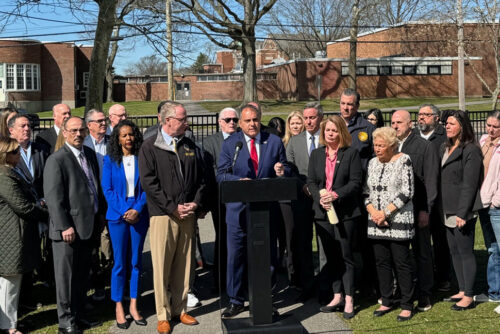
During a press conference appropriately held Thursday morning alongside two tracks of an old freight line in Garden City, Governor George Pataki announced the Metropolitan Transportation Authority (MTA), Long Island Rail Road (LIRR) and the New York & Atlantic Railway (NYA) finally reached an agreement ensuring the Hempstead branch be permanently closed off to freight traffic and be used only for passenger commuters.
|
|
Senator Kemp Hannon noted he's spent five years working on this specific aspect of Long Island rail freight, with the help of many, including Town of Hempstead Councilman Joe Kearney, Governor George Pataki, Assemblywoman Maureen O'Connell, former Garden City Mayors Frank Tauches and Hal Hecken as well as Mayor Robert Lewis.
|
Moreover, the agreement will streamline the movement of rail freight on Long Island by taking more trucks off the road. It will also bring East Side Access to Grand Central Terminal, an issue Pataki considers top priority because it will enable commuters to have direct rail service into Grand Central Station.
Residents living along the tracks that run parallel to Merillon Avenue are particularly upset about this new agreement. One resident, who moved to the village three years ago and lives just houses away from the Merillon Avenue station, which stops in Hicksville, said, "All of a sudden they state there'll be no more freight in Garden City. What about residents who only live a few houses away from the Hicksville line?" he said.
"Besides the present noise factor of commuter trains rolling at night, we have to worry about our property values dropping. I don't know how they can arbitrarily move freight from one line to another without consulting the residents it directly affects."
A Houston Road resident said she's very "uptight" about the agreement. "Once again the politicians have kept affected residents in the dark. They're so proud no more freight will run on the Hempstead line but now it'll run on the Hicksville line, which goes through Garden City as well," she said. "There's enough traffic, noise and pollution on this line already. Now we'll have to deal with freight running on it as well?"
State Senator Kemp Hannon said Monday that there will be rail freight but there really won't be more trains. "What they can do, and it makes economic sense in terms of getting rail off the roads and onto the cars, is to just add cars. In other words, there are 10 freight trains a day but there's only right now an average of 8-10 cars. You can double that and make the rail operation profitable and get the stuff off the roads and the whole thing works. Then you ask yourself, 'are they going to add more trains?' It's really a commuter line and the first precedence goes to the commuter line."
MTA LIRR President Ken Bauer said the project presented all parties involved with an unusual and perhaps unique opportunity to work across organizational boundaries while solving an interesting problem.
"Working outside of our boxes, we were able to construct a creative solution with elements that were tailored to the needs of all parties involved. For the LIRR's part, we get Yard A and Arch Street, both extremely important to the East Side Access project," Bauer said.
"Although all of our issues were addressed, it's the quality of life on Long Island that is the biggest winner. Using existing railways on Long Island, we've devised a plan that will help make Long Island an even better place to live. I'm proud of the part the LIRR played in this agreement."
The LIRR and NYA will exchange storage yards for equipment and trains. Specifically, the LIRR will provide NYA with a Hicksville Yard facility in exchange for the Garden City Yard facility. Certain usage fees will be adjusted to make the freight business more competitive and, in return, NYA has agreed to increase royalty payments by as much as 100 percent to the MTA. The old freight line in Garden City, which runs alongside the firehouse on Clinton Avenue, will be permanently closed to all future rail traffic, with the exception of the Ringling Bros. and Barnum & Bailey Circus train heading toward the Nassau Coliseum once a year.
"Back in 1997 we took a major step working to get commercial traffic off highways and local roads and onto the freight system when we privatized the LIRR freight operations. Here in Garden City, and in some other places along the Hempstead branch, there was a lot of concern about areas that had once been used for passenger service only to be inundated all of a sudden with commercial freight traffic," Pataki said.
Pataki said there's more to the agreement. "In exchange for some other properties, we're lowering fees the LIRR has charged to the NYA so that, as they attract more freight, we will get more in fees. But as they go through the transition period of trying to get freight off the highways and onto freight lines, they will not be at a financial risk," he said.
In exchange for that, the NYA is transferring two important rail yards in Long Island City, Yard A and the Arch Street Yard, to the LIRR. Pataki said gaining control of these two yards is an important step in making sure the East Side Access project moves forward.
Assemblywoman Maureen O'Connell and Hannon are among many whom fought for years to make sure this came about. "This issue goes back more than a decade when many citizens in the Garden City community brought potential problems that freight rail would cause to our attention," O'Connell said. "This has been a long time in the making and the hard work of many, many, many people. This agreement will forever put to rest the issue of freight in Garden City."
When he looked at his calendar Thursday morning, Hannon realized he had been among those working on this specific aspect of Long Island rail freight for five years. Thanking Pataki's initiatives, Hannon said, "We can talk about solid progress in achieving goals important to all Long Islanders, as well as achieving a vital goal for all those living along the tracks of the Long Island Rail Road which runs to Mitchel Field.
"The benefits of finally developing a freight delivery system will provide an additional boost to the rejuvenated economy of Nassau and Suffolk ... Having a reliable and secure freight system from trucks to rail will alleviate the daily pressures on drivers as well as future pressures to expand the roads."
The NYA took over freight services from the LIRR in 1997 with a mission to increase rail freight on the island and in New York City. Bruce Lieberman, NYA chairman, noted New York and Long Island have the lowest percentage of freight shipped by rail when compared to any other metropolitan area in the country.
"It's the reason why we're seeing so much truck traffic; it's the reason why so many shippers have high costs and many companies have left Long Island. Since 1997, we have diligently pursued the development of rail freight on Long Island," he said.
" We're convinced there's a significant opportunity to increase rail freight on Long Island. This agreement will enhance NYA's ability to compete with the trucks that rail freight. We want to competitively fight for rail traffic on Long Island and this agreement allows us to keep infrastructure open and to price our service competitively."
The original agreement to privatize the LIRR's freight operation was part of Pataki's plan to have a robust rail freight operation in the downstate area and reduce the region's dependence on trucks. As part of the larger effort, New York State invested significant dollars in rail freight infrastructure improvements throughout New York. Current plans in the region also include improving height clearances to allow rail flatbed cars to carry loaded trucks and a new intermodel facility east of Mineola.