By Susie Trenkle
There were 25 members of the community who spoke at last Tuesday's Public Hearing on Benefit Assessment, with only six speaking in favor of the proposed property acquisition and one opponent even suggesting that the implementation of the plan could lead to the end of the village's Community Agreement.
The hearing began with outgoing Mayor Harold Hecken explaining that this was a benefit assessment hearing and an opportunity for the public to comment on the purposes of acquiring property. Hecken noted that to benefit assess property is a two-part process. The first step, this hearing, is to provide an opportunity for residents to comment on the purposes of the proposed acquisition and the question of whether benefit assessment is the proper tool to use with regard to the proposed property acquisition. The details of the benefit assessment, such as who would be in the district that is slated to benefit from such an acquisition and how much each of the property owners in said district will be required to pay is the second part of the process. "The purpose of tonight's meeting is more of a limited nature, to comment on whether it is an appropriate situation to go forward with the improvement and whether benefit assessment is the appropriate vehicle," stated Hecken, concluding that no action would be taken that evening.
The first speaker, James Hutcherson commented that that if the village plans to take property by eminent domain, it must be for a good public purpose. While many opponents of the proposed acquisition echoed these sentiments, other opponents, such as Ronald Young, the second speaker, suggested alternatives to property acquisition. Young suggested that the village widen Franklin Avenue by two lanes between Fifth Street and Old Country Road, to allow for more lay-by parking on either side. He said that this would slow down traffic as well as provide adequate parking. He questioned, if by tearing down a house and paving over the property, the village was trying to turn Garden City into "Garden City City."
Many residents questioned the need for additional parking when there are often empty spots in the village parking lots and parking is always available on the eastern side of Franklin Avenue. Jacqueline Sandler questioned, "I just wonder if the ultimate plan is to just have a vast area of half-empty blacktop from Franklin to Hilton." LucyAnn Coffey echoed the sentiments about the availability of parking and asked the board to "Keep the garden in Garden City."
The concern about loss of greenspace was carried on by Robert Alvey who, because he was away on business had his wife, Suzie, read a letter he had written to the board. In the letter, Alvey discussed his contributions to the community with regard to maintaining greenspace, including the creation of a bird sanctuary. He then juxtaposed these efforts, with the proposed parking plan. "I reject the argument that there is no cost to the village by taking properties," said Alvey. "The financial 'Benefit Assessment' is erroneous. The Damage Assessment is shared by all residents of the village. The cost is too high and the benefits are too few. The temporary benefit for a few businesses is far outweighed by the permanent damage to the village." He then noted that the parking and traffic problems in the village would never be eliminated. He further commented on the fact that the village has recognized the environmental problems associated with increased paving of residential properties, which recently led them to propose a law limiting the expansion of residential driveways. He requested that the trustees consider new ideas and solutions rather than recycling the parking buffer strip plan.
Maureen Valente also spoke about the loss of greenspace and then went on to say how sad it is that so many proponents of the parking buffer strip plan keep mentioning that there are only four homes left in the plan. She then went on to comment on a flier sent out by the chamber of commerce. She said that she spoke to the businesses that she goes to in the village who are members of the chamber of commerce, and discovered that 90 percent of the business owners she spoke with were not even aware that the chamber had sent out the flier.
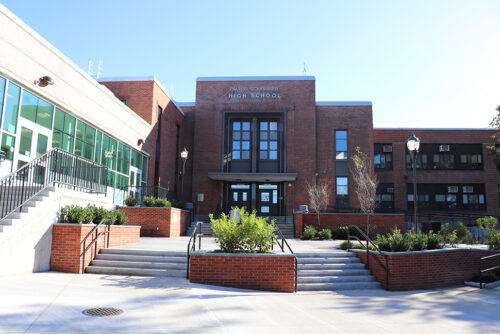
Craig Biscone, a St. Paul's Crescent resident, noted that this issue is not about the "Numbered street NIMBYs vs. the Albanese Organization." He said that this is a concern to him as a resident because he has the soccer fields to the south of his home and the high school to the north, both areas which could use additional parking. He questioned, "How long before my neighborhood becomes the target for the next parking expansion?" Biscone further commented, "This is a village of homes with a business community. It's a planned community, we have to respect that. It's not a business community that happens to have a few homes." Biscone concluded by remembering a song from his childhood, about not knowing what you have until it's gone, when someone, "paved paradise and put up a parking lot."
John Amrod, who lives two houses down from the Gardner property on Sixth Street, where the village is considering acquiring 100 feet for additional parking, was the next speaker. Amrod, in the interest of full disclosure, stated that he is a tenant in the 1000 Franklin Avenue building, is a former deputy village attorney in Garden City, and is the attorney for the estate of Ruth Gardner. He noted that the bulk of the Gardner property is being sold to contractors so if the property acquisition does not work out, those additional 100 feet can also go to the contractors. Amrod said he believes that there is no need for this property acquisition, either on Sixth Street or on 11th Street and said that he has driven around those lots and seen available parking. "This crave to pave has gotten out of hand," said Amrod. He added that he was, in essence, told by the village attorney that if the Gardener estate did not sell that 100 feet of property to the village, the village could acquire it by condemnation.
Robert Nouryan, interim president of the Central Property Owners Association, stated that he had intended to address the board as a resident but he felt the need to defend the CPOA. "The CPOA includes 19 volunteers who are your neighbors and represent your constituents," said Nouryan. "We are reflecting the wishes of the Central Property owners who live in our district." He then asked the board to postpone their vote and consider the desires of their neighbors throughout the village, who have expressed their opposition to the proposal.
Pat DiMattia, a director of the CPOA, also asked that the board consider the residents who they represent, many of whom have spoken out against this plan.
John McKay, chairman of the CPOA's Parking Subcommittee, said he wanted to discuss benefit assessment, but not in the same way that was being considered by the board, which was the consideration of the benefit to the commercial area. "I don't think that this project and this acquisition will benefit the residents of the Central section and we are the most affected by this acquisition, "said McKay. "I only see one particular organization that will benefit and I have a problem with that because I don't think that's the nature of the acquisition and the basis upon which it should be made." He concluded by asking the board to follow the planning commission's recommendations and only take a house as a last resort.
Kevin Curtin asked that if the board does follow through with the parking strip buffer plan that they then file the buffer as designated parkland with the proper state officials so that the barrier is guaranteed to remain parkland and not be taken for additional parking in the future. Curtin then questioned the mayor about the fact that in making his decision to vote in favor of considering the property acquisition he cited Frank Tauches, Roger Eltringham and Bertram Donley. "Since you didn't cite me or anybody in the subcommittee or anybody that I know in the CPOA ... I just wanted to ask, for the public record as you made it the rationale for your vote, were you aware of any business or financial relationship between the Albanese Organization and its affiliates and/or the owners of the medical building between Fifth and Sixth Streets and those gentlemen?" He asked that the mayor reflect on that question and provide the public with an answer at a future date. Curtin concluded by commenting on the permanence of tearing down a home for the purpose of turning it into a parking lot, stating, "Once a pickle, never a cucumber again."
Jack Pascal was the final resident, not on the board, to speak in opposition of the parking buffer strip plan. He said he was looking at this issue from a different angle and reflected on the divisiveness of the issue. He noted that this plan has pitted two groups in the village against each other, which he said concerns him. "We have, in this community, a gentleman's agreement and that's how it's been governed since its inception, for over 100 years and it's been done in a civil manner ... We have, apparently, a large group of residents who are concerned about this and did not have an opportunity to express their concerns through a political party. Elsewhere in this country we have political parties that represent interests. What we have here has worked for over 125 years and we better be careful that we continue to have it work the way it has." Pascal said that he would not want this issue to boil over to the point where people want to take action in different ways.
Gregory Moore was the first resident to speak in favor of the property acquisition. "My heart drops when I go up and down Franklin Avenue and see all the empty stores and empty spaces and I would like to help the business community as much as possible where it is appropriate and one of those things would be to enlarge Parking Field 10," said Moore.
Stephen Garber, a member of the Polimeni organization, which owns 1000 Franklin Avenue also voiced that organization's support of the acquisition.
Anthony Albanese, resident of the village and owner of the Albanese Development Corporation commented on a flier that had been delivered by the CPOA and prompted the mailing of the chamber of commerce's flier. Albanese said that the CPOA flier continues a pattern of misinformation and distortion of the truth, ignores the recommendations of the planning commission, mocks the process of study deliberation and decision-making, continues to delay the process, and pits tenants against landlord and landlords against him. He then commented on the fact that all of the property owners' associations voiced their support of the plan, as did the chamber of commerce, the business planning coalition, and the planning commission. Albanese then spoke about how effective and non-invasive the parking buffer strip plan was when it was implemented on Ninth Street. "The Village of Garden City Parking Buffer Strip Plan has worked well for more than 40 years. According to Albanese, for the board to do anything other than implement the plan "would be shameful."
Althea Robinson, executive director of the Garden City Chamber of Commerce, received a very rude reception when she spoke in favor of the plan. She noted that she has been attending trustee meetings for the last 30 years and has watched the parking plan develop. She further noted that this is not a cause that the chamber just recently became involved in. She said that the chamber of commerce has supported this plan since its inception. Robinson then went on to say that despite people's fears about homes being taken all over the village, there are only four houses left on the plan, a comment which riled those in opposition to the plan. Hecken cautioned the audience to respect the speakers. After the audience settled down, Robinson noted that in this instance, there is only one house being considered. With regard to comments about the number of open parking spaces, Robinson stated, "Yes, we all know that there is plenty of parking in the village but unfortunately it's not always where the parking is needed." She went on to address the residents who have questioned how she would feel if it were her house that was going to be next door to a parking lot. "I would only say that if somebody would promise me a beautifully landscaped buffer strip next to my house, I don't think I would care what was on the other side," a comment which received more rude remarks from the audience.
Former Mayor Richard Benack also spoke in favor of the buffer strip plan, discussing how the Albanese Corporation was promised the expansion of that lot when the property became available. He noted that when Garden City needed a boost to the economy, the Albanese Company wanted to build their buildings on Franklin Avenue but that there wasn't enough parking for the proposed buildings. At that time, according to Benack, the Albaneses, if only with a handshake, were promised that when 114 and 116 Eleventh Street and 116 Tenth Street became available, Parking Field 10 would be expanded. "Keep the Village of Garden City honorable, as the way all of us believe it is and do the other half of the agreement," Benack implored the board.
The final speaker in favor of the proposed acquisition, was Ross Mongiardo, president of the Garden City Chamber of Commerce. He commented on a two-page advertisement in a local paper, which listed hundreds of names opposing the proposed acquisition. He noted that there were duplicate names on the list and there were the names of minor children, one as young as three on the list. He went on to address the concerns of those in opposition to the plan. "Cost- Not an issue since 90 percent of the cost is benefit assessed to commercial property owners and the other 10 percent is being voluntarily borne by the Albanese Organization; 'It is intrusive'- it is not. There will be a 50 foot, landscaped buffer strip between the parking and the last home; 'We are moving with legendary speed'- We are not, the issue has been studied, debated, and analyzed for years; 'Other Alternatives have not been explored'- a great deal of time and energy has been spent by some very bright people exploring other alternatives. The village retained a well-respected firm, BF&J, at considerable cost to do the same. None was able to come up with an acceptable alternative to the plan before you now." He then went on to ask the board not to be swayed or delayed by a last-minute plan put forth by someone who is not a parking expert. Mongiardo then went on to comment on the fact that the success of the business community is good for Garden City residents. "Tax revenue is a zero sum game. If businesses pay less taxes, residents pay more," said Mongiardo. "The stock market is tumbling and your real estate taxes have been rising swiftly for years. Most of us can't do much about Wall Street, but we can do something about your taxes- support your local business community." He concluded by asking the board to consider the entire community, not just residents who live on Ninth, Tenth and Eleventh Streets.
Following comments from the public, outgoing Trustee Bruce Torino noted that very little was said about benefit assessment. He said that had been the real purpose of the hearing, not just the rehashing of the same information that has been presented before. He noted that the members of the chamber of commerce are friends and neighbors and commented on the fact that residents need the business community just as businesses need the residents. He said, the question then becomes about cooperative efforts, adding that both the CPOA and the chamber have spent a great deal of money that will never be seen again on this issue. "The money will be gone, the issue is still with us," said Torino. He said that the question was, "What is it that we can do to reach the cooperative effort of a middle ground?" Torino then commented on the fact that as of yet, there are still many questions with regard to the benefit assessment, which have yet to be answered.
As of the Garden City Life's press time the board has not yet said when the questions of who would be in the benefit assessment district, how much it would cost, and if the board would be going forward with the property acquisition would be answered.