News Sports Opinion Obituaries Contents
News

Dr. Steven, Chu, a 1966 graduate of Garden City High School, and 1997 winner of the Nobel Prize in Physics, returned to his alma mater last Monday to speak to science students from the elementary schools and high school.

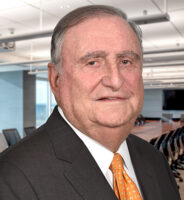
Superintendent of Schools Dr. Stephen Leitman, Nobel Prize winner Dr. Steven Chu and Board of Education President Linda Leone.

Currently a professor of Physics and Applied Physics at Stanford University, Dr. Chu was awarded the Nobel Prize for his study of the laser cooling and trapping of atoms. He is also the recipient of the Herbert Broida Prize for Spectroscopy, the Richtmyer Memorial Prize Lecturer, co-winner of the King Faisal International Prize for Science, the Arthur Schawlow Prize for Laser Science, the William Meggers Award for Laser Spectroscopy, and the Science for Art Prize. In addition, Dr. Chu received a Humbolt Senior Scientist Award in 1995 and the Guggenheim Fellowship in 1996.

Superintendent of Schools, Dr. Stephen Leitman and Board of Education President Linda Leone presented Dr. Chu with a certificate in recognition of his return to Garden City. "We're honored that you're here and honored that a graduate of Garden City High School won the Nobel Prize," said Leone.

Dr. Chu said that it was actually a little scary for him to return to the high school after all these years. He informed the elementary school students that he had attended Stewart School for elementary school, where he also worked as a janitor's aide when he was a bit older.

"I got a great education in Garden City," said Dr. Chu. "It was a fabulous education where I got into the habit of learning and working and deciding what I really wanted."

Dr. Chu noted that there is more to education and learning than what you find in a textbook. True learning, according to Dr. Chu, is being able to look at things and see it from different angles. He said that he found one of the best ways to learn is by talking to classmates and trying to teach each other. "You can look at school as an avenue to get a better job," Dr. Chu told the Garden City students, "but fundamentally, school is a way to do something incredible- to learn."

The floor was then opened for those present to ask questions of the Nobel Prize winner. When asked what inspired him, Dr. Chu responded that his parents had a major influence on him as did a terrific physics teacher he had in Garden City.

When asked how he felt when he won the Nobel Prize, Chu responded that he was relieved. He noted that once he won the prize he was able to get back to actual science. He went on to state, "It was rewarding to do something that had a great influence on science."

In response to a question about whether he was glad he went into physics, Dr. Chu said that physics was a good choice because through physics he also gained an understanding of nature and mathematics and can do other things in addition to physics. He recommended that students learn math at a young age since other sciences are becoming more and more quantitative.

Another area that Dr. Chu stressed the importance of, to the students, was writing. "It can't be overemphasized how important clear writing is," said Dr. Chu. "He went on to describe writing as a window into somebody's mind. He explained that if you have something to say, you don't want to cover it up and unclear writing is like covering up what you are trying to say. "A significant part of science is how well you communicate your ideas to others," said Dr. Chu.

When asked about his favorite science projects, Dr. Chu spoke about an experiment where he cooled and trapped atoms with light and another one developing a method to manipulate DNA using molecular tweezers.

Very often, according to Dr. Chu, what scientists list as what they are studying when applying for grants, turns into a whole different type of research project from what their research proposal was. Through the research, said Dr. Chu, the scientists make other discoveries and become diverted. Dr. Chu went on to note, "The most thrilling discoveries are the accidental ones. Then you start thinking about what it means and where you go next." He told the science research students from the high school to follow their noses when doing science experiments.

In response to a question about whether ability in science was innate or learned, Dr. Chu expressed the belief that it was both. He noted that although there is some innate ability, a lot can be taught. Dr. Chu added, "The most important thing a teacher can teach a student is that eventually they can learn on their own."

Dr. Chu stated that the fundamentals, reading, writing and arithmetic were the most important things to learn, along with the knowledge that it is fun to learn. "It's plain fun to learn and understand. It transcends science," concluded Dr. Chu.


LongIsland.com Logo
An Official Newspaper of the
LongIsland.Com Internet Community


| antonnews.com home | Email the Garden City Life|
Copyright ©2000 Anton Community Newspapers, Inc.
All Rights Reserved.

LinkExchange
LinkExchange Member

Farmingdale Observer Floral Park Dispatch Garden City Life Glen Cove Record Pilot Great Neck Record Hicksville Illustrated News Levittown Tribune Manhasset Press Massapequan Observer Mineola American New Hyde Park Illustrated News Oyster Bay Enterprise Pilot Plainview Herald Port Washington News Roslyn News Syosset Jericho Tribune Three Village Times Westbury Times Boulevard Magazine Features Calendar Search Add An Event Classified Contacting Anton News