By Amy Edel
The Waldorf School of Garden City, which celebrated its 50th anniversary in 1997, is part of an international educational history, which began 80 years ago. In post WWI Germany an Austrian born man who was not only a scientist and an educator, but a philosopher, began to question the forces behind modern war and its ramifications. This philosopher, Rudolf Steiner (1861-1925) concluded that to avoid the senselessness of war and the chaos it brings, individuals needed to be educated differently from the start. He initiated the opening of the first Waldorf school in 1919 in Stuttgart, Germany, through the sponsorship of Emil Molt, owner of the Waldorf-Astoria cigarette factory.
The first Waldorf school was coeducational and tuition free and educated the children of factory workers. The focus on the creative arts and the structure of the institution was radically different from what was then the norm in education. This school was closed by the Nazis in 1937, but the philosophy of the Waldorf school had already begun to gain popularity internationally. The first Waldorf school in North America was opened in Manhattan in 1928 and today there are close to 700 such schools in 40 different countries.
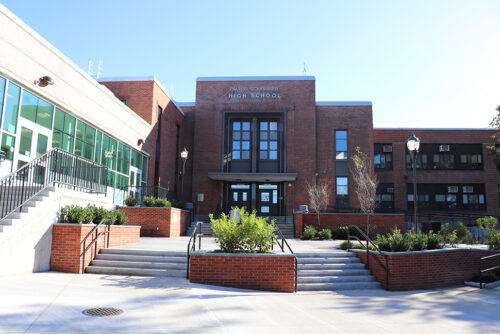
Located on a 10 acre campus in the Village of Garden City, adjacent to the Adelphi University campus, The Waldorf School in Garden City has been keeping the Steiner philosophy alive. The school educates children from preschool through grade 12 with children in pre-K being introduced to French and children in kindergarten being introduced to German. Students in grades 1 through 12 have a 90-minute main lesson daily as the foundation of the school day, which is an interdisciplinary extended lesson in English, math, history, geography or science.
The nursery class is comprised of 3 and 4-year-old students with two teachers who meet from 9 a.m. to noon and students can attend two to five days a week. The pre-kindergarten class educates students who are 4 and 5 years old and also has two teachers. This class meets from 8:10 a.m. to noon. A French teacher visits twice a week and a eurythmy teacher visits once a week. There is an optional afternoon playgroup for which the children may stay.
The playgroup meets from noon to 3 p.m. daily and while parents can opt for any schedule of attendance for their children, commitment to that schedule is required. Class size is limited to 11 children with one playgroup teacher. The children bring their own lunches and eat at a table set with tablecloth and centerpiece with their teacher. After cleanup the children rest and hear a story, followed by active play time.
The kindergarten is for children who are 5 and 6 and will enter first grade the following fall. Two teachers lead the class and there are two periods of French and one period of German taught by language teachers each week. Once a week the students attend a eurythmy class in Bonner Hall. The class meets Monday through Friday from 8:10 to noon and all children may join the afternoon playgroup.
Once a week there is a parent/toddler group for 2 and 3-year-olds with their parents and two preschool teachers. The class meets from 1:30 to 3 p.m. Activities include singing, reciting rhymes and verses, cooking, baking, watercolor painting, seasonal crafts, storytelling, and puppetry. Classes are limited to 12 families per session.
In the first grade children are introduced to literature through fairytales and poetry and learn to recite poetry throughout the year. Children are introduced to science through nature stories and to arithmetic through concrete connections between examples and numbers with storytelling and math problems related to the story. Second grade children build on the fairytale telling of the previous year with introduction to the hearing and retelling of fables and legends. Notebooks, acting out stories, and word games are employed to develop writing and reading comprehension skills. The four math processes are explored.
Third graders are introduced to the Old Testament Bible as the foundation of their literary explorations and begin to study the principles of writing. By examining farming and house building scientific principles are studied. Fourth graders explore Norse myths and begin to examine the geology and local history of their home here on Long Island. Zoology is introduced and math is strengthened with fractions.
Fifth graders study the theology, culture, and history of ancient worlds and foreign lands, as well as American geography and history. Botany, mathematics, and meteorology are only some of the subjects explored. Sixth graders study geology and astronomy. History lessons encompass the founding of Rome to the fiefs of Medieval Europe. Scientific experiments explore light and sound while math lessons expand to encompass geometry, business math, ratios, and percents.
Junior high school at the Waldorf School in Garden City brings with it the study of the Renaissance, the role of religion on culture, world geography, nutrition, the metabolic process, chemistry, the physics of mechanics, signed numbers, algebra, formal grammar, and a variety of writing experiences. By completion of the eighth grade students are adept in physiology, world geography, American and world history, chemistry, physics, math, geometry, speech, recitation, and drama.
Ninth graders study History Through Art, Modern World History, 20th Century U.S. History, History of Revolutions, History of Drama, American Literature, Poetry, Physics: Heat, Food Chemistry, Biology: Human Senses, and Physical Geography. Students must complete a ropes course at Glen Brook, the school's 200 acre camp in New Hampshire. The high school chairperson is Roland Rothenbucher, M.A. and there is an on staff college advisor, James Malone, Ph.D. to work with the students towards shaping their future academic goals throughout their high school careers.
Tenth graders take History through Language, Ancient History, The Odyssey, Old Testament, Projective Geometry, Physics: Mechanics, Organic Chemistry, Physiology I, Physiology II, Physical Geography, and Cultural Geography. Students explore the geological sites in the White Mountains of New Hampshire and climb Mt. Washington as part of their study of physical geography.
Juniors take History through Music, Medieval History, Renaissance History, Medieval Romances, Shakespeare, Electricity, Acids and Bases, Cell Biology, Botany, Conic Sections, and Cartography. Part of the cartography study requires students to return to Glen Brook and find their way about the camp with a compass and a topographical map. Students also choose, memorize and recite a poem before faculty and the student body during the semester. Each student is required to participate in a dramatic performance for the annual Literary Gourmet Dinner.
Physics, Chemistry, Biology, and Earth Science are integrated into the course work each year and Juniors and Seniors may elect to take a two-year sequence of topics in biology, chemistry and physics. In the Arts, students study charcoal drawing, clay sculpture, woodblock printing, woodworking, calligraphy, pottery, still-life painting, stone sculpture, landscape painting, drawing, ballroom dancing, and eurythmy. Available electives, which are ungraded, include, Archaelogy, Astronomy, Chorus, Drama, Ecology, Eurythmy, Literary Magazine, Madrigals, Model United Nations, Orchestra, and Yearbook. There are also two-year electives for credits including topics in Science or a second foreign language.
Seniors study History through Architecture, 19th-20th Century U.S. History, 20th Century World History, The Transcendentalists, Russian Literature, Topics of Contemporary Life, Optics and Astronomy, Qualitative Chemistry, Zoology, Genetics and Evolution, and the senior play. In June the entire senior class presents a full-length play. Also, at the weekly assembly, each student presented a 15 minute formal speech to the faculty and student body. Current events or "hot topics" are discussed at planned forums planned and moderated by seniors on a monthly basis.
Visiting college professors often teach courses at the school. For example, last year Food Chemistry and Organic Chemistry were taught by Dr. Ross of Fordham University. Contemporary Economics was taught by Dr. Herold of Hofstra University and Old Testament was taught by Dr. Goetz of Hofstra University. Mrs. Russell of Antioch College taught both Medieval Romance and Russian Literature. Last year seniors were accepted to schools across the country, including: American University in Washington, D.C.; Brown University; Boston University; Bucknell University; Drew University; Fairfield University; Georgetown University; George Washington University; Hofstra University; Ithaca College; Johns Hopkins University; Lafayette College; Lehigh University; Manhattanville College; Muhlenberg College; NYIT; NYU; Penn State; RIT; Rutgers University; St. Mary's College, MD; the SUNY schools; Tufts University; UMADS Dartmouth; University of Hartford; and the College of William and Mary.
The high school's Community Service Club has worked to help the Street Relief Program and brought food to Rufus King Park in Jamaica, Queens and served 120 hungry New Yorkers. Other extra-curricular activities include sports, music and drama. Students make annual trips to Glen Brook and learn gardening at both campuses. There are also seasonal meals and festivals throughout the year.
The Waldorf School in Garden City was founded by Dr. Hermann von Baravalle, a teacher from the first Waldorf School in Stuttgart. During the Nazi occupation of Germany, Dr. von Baravelle moved to England and then New York. In 1943 he became a replacement teacher for the retiring math chairman at Adelphi University, then Adelphi College. He was eager to bring the Steiner philosophy to Garden City, and with the help of then Adelphi President Dr. Paul Dawon Eddy, the Waldorf Demonstration School was created under the charter of Adelphi.
The school opened in Garden City in 1947 with only two classes. John Fentress Gardner, a teacher at the Waldorf School in Manhattan, was hired as director of the school in 1949. By 1958 a school complex for preschool through grade 12 was built. The first graduating class received their diplomas in 1960. In 1946 William Harrer, a teacher at the Manhattan school, bought farmland in Marlborough, New Hampshire, which became the Glen Brook camp, which became a nonprofit corporation and open to Waldorf use in 1971.
The Waldorf School in Garden City is located on Cambridge Avenue in Garden City.