Farmingdale Observer Floral Park Dispatch Garden City Life Glen Cove Record Pilot Great Neck Record Hicksville Illustrated News Levittown Tribune Manhasset Press Massapequan Observer Mineola American New Hyde Park Illustrated News Oyster Bay Enterprise Pilot Plainview Herald Port Washington News Roslyn News Syosset Jericho Tribune Three Village Times Westbury Times Boulevard Magazine Features Calendar Search Add An Event Classified Contacting Anton News

LongIsland.com Logo An Official Newspaper of the
LongIsland.Com Internet Community

News Sports Opinion Obituaries Contents

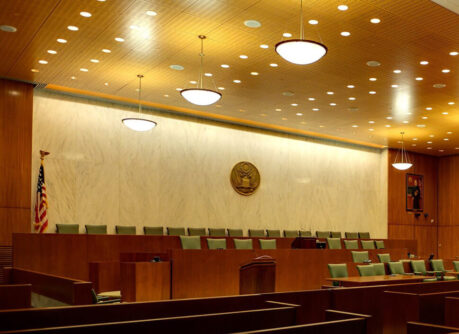
Chairman Hodges called the hearing on Feb. 4 to order at 9:30 a.m. and said it would take all night if he thought it would get the issues before them resolved.

Much to the dismay of what was left of the crowd that had gathered in the audience that morning, around 4:30 p.m. it seemed like it was going to do just that. Several witnesses, having heard that the hearing was going to continue to March 3 had returned to work and gone to conduct other business after the lunch break, much to the irritation of Chairman Hodges, who said that while he'd scheduled the continuation day, that in no way meant he planned to pack up his show by 5 p.m. He commented that unlike the courts to which the lawyers present were accustomed, he didn't end his day at quarter to five. Finally, a little after five Chairman Hodges decided to adjourn the hearing until 3 p.m. on March 3 and attendees were left to themselves to examine the events of a very long and often tense day of testimony, cross examination, redirect, and too many objections to count.

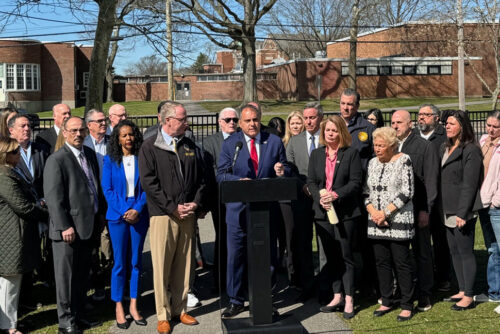
Just some of the Village officials and representatives in attendance at the hearing in Town Hall. (L to R): Mayor Frank Tauches, CPOA President Dr. Barbara Miller, Mall Opposition Effort Organizer Trustee Bruce Torino, Village Counsel Gerard Fishberg, GCUFD Superintendent of Schools Dr. Lee Wilson, and Village Administrator Robert Schoelle.

Roosevelt Field Mall attorney Ballin attempted to begin his case that morning by refuting accusations that the fences and mounds of earth where the proposed Saks store at the mall would be built represent an overconfidence in the outcome of the proceedings before the Board of Appeals. He argued that work has not begun and the fence and ripped-up parking lot are unrelated to the request for a variance. Chairman Hodges set the tone for the day by interrupting him and telling him that it was irrelevant and immaterial and he'd best move on to other ground.

Ballin argued that the purchase of the Andover parcel of 514 parking spaces, which have never been in use, changes the FAR issue and would then make the expansion "insignificant." He also added that with the addition of a level of parking to the garage by Bloomingdale's would truly make any loss of parking on the west side of the mall "insignificant" and would thus make the whole project's impact "insignificant." He then attempted to enter into evidence a survey by Newsday which apparently found that the shoppers from the other anchor stores in the mall also shop at Saks in an attempt to establish the mall's need to expand.

Trustee Torino, leading the Village's efforts as an attorney, objected immediately on the grounds that the survey would be hearsay, as the mall had no plans to call anyone from Newsday to testify regarding the survey. The objection was sustained. This was only the first of many conflicts during the proceedings. Ballin had wanted certain pieces of the record from hearings held in the past regarding the mall to be individually entered into the record, the objection to which was sustained, and indicated the view early on by Hodges that he preferred to have the proceedings move on and have written documents submitted for the Board's reading later. Despite this, several witnesses, including the Village's expert on traffic who was called after lunch to refute the testimony of the mall's expert and leaders of several Village groups. Hodges said repeatedly throughout the day, "We can all read, and you are not reading that whole thing to me or pieces of it. Summarize, make your points and move on."

Donald Uselmann, director of several Saks stores, testified that Saks in Garden City is suffering and several of the vendors are threatening to leave them at the Garden City location, but have said they may stay with Saks if they move to the mall. He said that currently Saks does $17 million worth of business, but could increase that to $51 million at the mall. He says it takes a small number of customers to drive that kind of business as he says their customers have large disposal incomes and spend large amounts at once. He consistently referred to his customers as "she" and said that "she" wants them to move to the mall, where "she" now shops almost exclusively.

Village Counsel Fishberg was able to also ask cross questions during the morning session, something Hodges refused to allow after lunch, and asked Uselmann what would become of the Garden City Saks if the mall's request for the permit was denied. Uselmann said the store would close anyway. When asked why they didn't seek expansion in the Village like Lord & Taylor, Uselmann said that it was not an issue of space, but lack of customers in Garden City.

Senior Partner for VMI Traffic Consulting in Hackensack, NJ, Mr. Ivarrone then testified on behalf of the mall. He claimed that his studies of the mall area indicate that the increase of traffic that would be generated by the expansion would be so insignificant (a term used constantly throughout the day by Ballin and his witnesses) that he said he saw no reason not to grant the permit. The increase during peak hours, according to the witness, would be 2 percent, and the DOT holds that less than 5 percent is "virtually imperceptable." He proposed that the signalization be changed to help the Stewart and Clinton Avenues intersection, which is rated by traffic experts as an F currently, changing it to an E.

Ivarrone also noted that in 1995 when he testified and conducted a study for the Nordstrom expansion of the mall, that he had predicted traffic increases for 9 percent that what the 1998 counts show actually resulted. He said he personally observed the traffic around the mall during rush hour to determine what impact the mall's plans might have.

Torino questioned if factors like the plans for the Nassau Coliseum and other Hub development were taken into account in his study. Torino argued that these future plans, including the conversion of empty industrial space to office space, would generate tremendous amounts of traffic and when the mall traffic was added it would create a combined pileup of traffic. Ivarrone argued that studies of this nature do not account for future use of other space in the area. Torino questioned him about the possibilities new construction like the Wingate Hotel on Stewart Avenue outside of the Village could have, but Ivarrone continued to say that the traffic increase would be "imperceptible" and that such things are not taken into account in traffic studies. He also said that most of the shoppers at Saks would not be new traffic, rather shoppers already at the mall, so it would generate little new traffic.

When Fishberg and Torino questioned him about the loss of almost 400 spaces to the new construction, Ivarrone refused, despite several attempts to get him to do so, to really address the issue, stating that he's a traffic, not a parking expert.

Garden City's Superintendent of Schools Dr. Wilson was sworn in to ask questions, and asked the expert to address the fact that the study was not done during the day, when peak shopping hours and school hours coincide. Wilson said that the traffic base was smaller, but the percent increase was greater during the day, and this was in fact significant because of Stewart School on the corner of Stewart and Clinton Avenues. The witness simply repeated that a percent increase under 5 percent "can't be perceived."

After the lunch break, Stony Brook Professor and Planner Koppelman then testified for the mall saying that he felt the expansion was in line with mall development. He argued that it would be better for the area for the Saks store to go to an already existing mall than to be built in an undeveloped area. He argued that raising the FAR past .695 was not in his opinion "extensive" development. He called the .4 FAR "fictitious" and responded to Torino's line of questioning about "when is enough really enough" by saying that it's a judgment call and in his opinion Saks was best suited to the mall's location. He argued that he did not see the mall as "built out" and that there was room for more growth there.

Koppelman also added, in response to questions from the Village about the Hub proposals and possible "over-development" of central Nassau, that "The Nassau County Master Plan doesn't get down to specifics. You could almost read anything into it." He added, ".4 is not a magic number. It's a very conservative number in terms of planning. That's why they're here not seeking a special exception."

Wayne Hussey, a senior VP for Saks, then testified. He said Saks wants to reach the Long Island consumer with a "two prong approach" at the Walt Whitman and the Roosevelt Field Malls. He restated much of the testimony by Uselmann from the morning session. Fishberg questioned him about the surveys done about their consumer base and the business that they expect to do, as well as alternate locations for the Saks store if they are determined to leave Garden City, after which the chairman commented to Ballin, "That whole line of questioning by Fishberg was irrelevant and immaterial. I was waiting for you to object. It was interesting, but not pertinent."

The Village was then able to present its witnesses.

Dr. Wilson testified that the location of Stewart School presents many complications and safety threats for the school to address daily as it now stands, and that any increase in traffic, even if deemed "insignificant" by some, is serious for the school. He said that "almost all of our students come from the other side of Stewart and Clinton Avenues, and so we have to bus them across the street. This is not normal School Board Policy. We do this because even when we had a school crossing guard, we determined that it was insufficient." Arrivals, according to Wilson begin at 8 normally and as early as 7 a.m. for special programs. Parents with toddlers have to cross the street to pick up their elementary school students around 2:45 p.m., but with the after school programs, many kids leave during rush hour.

With playgrounds facing the road there are a number of safety concerns, according to Wilson (who was accompanied by Board of Education President Linda Leone, who did not yet get an opportunity to testify). He added that there is insufficient parking for events at the school, thus adding to the dilemma. He said that any increase in the possibility of some tragedy was not insignificant in his mind. He added that to get ventilation in the school the windows must be opened, leading to serious noise and air pollution issues, which is particularly serious for small children. He said movement into and out of the lots is quite difficult for the staff and parents and will certainly be perceived should it become worse.

Ballin then asked Wilson if he will also object to Hub development and further building on Stewart Avenue. Wilson said emphatically, "I'm concerned about the safety and well-being of children, staff, and parents. I will object to anything that will increase traffic by our school."

Wilson concluded, "I would not call the increase insignificant. The outcome of the effect on one person may not constitute a mathematical significance, but from a human perspective it does."

Ballin retorted, "I don't agree."

The Village's traffic consultant, Michael Solati, argued that even if the light changes proposed for the Stewart and Clinton intersection make that intersection an E, rather than an F, the intersections around it will become F rated as a result. He said that the traffic "spill over" will have seriously negatives effects on the entire surrounding area, and he questioned the mall's expert's numbers. He argued that there would be a greater percent increase in new traffic, and said he had a problem with the entire plan.

Sylvia Chertow spoke on behalf of the Nassau Council of Chambers of Commerce, Bert Donley spoke on behalf of the Garden City Chamber of Commerce, Dorothy Episcopia spoke as an active member of the EPOA, Mike Penigatos spoke as president of the East Meadow Chamber of Commerce, Eileen Murphy spoke as president of the EPOA, and Barbara Miller spoke as president of the CPOA.

Chertow stated that 35 to 40 Chambers met and discussed their opposition to the mall's expansion, authorizing her to speak on their behalf. Chertow said that the mall has already caused "a myriad of problems," in terms of the economic impact of downtown areas, traffic, and pollution.

Donley argued that the mall is already non-conforming and "generates considerable traffic." He said that before any expansion is allowed that theories like the people mover should be tested, rather than expanding first and testing theories later. He argued that "no one can coveniently travel to Garden City or East Meadow anymore." He said that granting a permit would be "aiding and abetting the predatory nature of the mall." He also argued that in light of the County's efforts to improve downtown, it would be contradictory to allow the mall to expand.

Epsicopia testified that Joe Mondello had raised concerns in 1989 about the water table and any future expansion's impact. She argued that as the water situation has not changed, that this was only one compelling reason not to allow the .4 FAR to be violated any further and she urged the Board to uphold the beliefs voiced by the Town in 1989.

Penigatos said that the East Meadow Chamber voted unanimously to oppose the mall's growth and that East Meadow has already been hurt economically by the mall.

Murphy argued that allowing the mall to grow would be "unconscionable" and that she was there representing 2,700 families. She also read a letter from residents on Raymond Court by the Stewart and Clinton intersection and the mall, who pleaded with the Board to not allow the traffic situation to get any worse and further adversely impact their quality of life, which they wrote is already diminished because of the 1995 expansion.

Miller testified that even as far as west of Franklin Avenue the impact of the mall's traffic can be felt. She said that the roadways of the Village have become "mini-highways" and that the families of the Village are troubled by safety concerns and quality of life issues. She urged them to deny the appeal for any kind of variance and stressed that this is not an issue of opposing Saks, but any future growth of the mall.

Following Miller's testimony, the chair called the hearing to a close for the day as exhausted spectators, the three media representatives remaining, and the witnesses and Village officials who had tenaciously worked all day to present their case and question that of the mall, all made their way out into the rain. The next session will be March 3 at 3 p.m. and all residents who can are asked to come and speak on behalf of the Village.


| antonnews.com home | Email the Garden City Life |
Copyright ©1998 Anton Community Newspapers, Inc.
All Rights Reserved.
LinkExchange
LinkExchange Member