The Long Island Rail Road (LIRR), working closely with the New York State Departments of Environmental Conservation (DEC) and Health, and the railroad's consultant, have developed a remedial action work plan to clean up a railroad-owned substation on Plainfield Avenue (opposite 111 Plainfield Avenue) in Floral Park this summer. The removal of contaminated soil from the site, found to have traces of mercury, arsenic and lead in it, is expected to commence this July.
|
|
A site map of the contaminated Long Island Rail Road substation located on Plainfield Avenue in Floral Park. Trace amounts of mercury, arsenic and lead have been found in the soil.Map courtesy of the NYSDEC
|
According to the DEC, approximately 760 cubic yards of contaminated soil are planned to be removed from the site and following the excavation, end point samples will be collected to ensure the soil clean up objectives have been met. DEC officials note that, if necessary, additional soils may be excavated.
The soil removal will take place in two phases - this summer and next summer - and will remove the source of contamination from the site and reduce or eliminate exposure to receptors. Further, LIRR President Helena Williams noted in a letter to local officials that between the soil removals, a new structure would be constructed to serve as the substation. The old structure would be retained as a storage building.
Residents can view the remedial action work plan, dated January 2008, at the Floral Park Library, located at 17 Caroline Place in Floral Park. Floral Park Mayor Phil Guarnieri and the full board of trustees, as well as residents within the area of the Plainfield Avenue substation, were notified of the pending cleanup in a formal letter and an informational fact sheet received April 21, Earth Day.
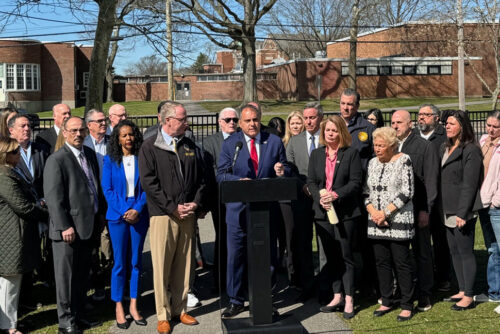
"Only the LIRR could fail to appreciate the irony of informing our village, on none other than Earth Day, that they will be transporting contaminated soil out of its substation, which is located on Plainfield Avenue," Floral Park Mayor Phil Guarnieri told the Floral Park Dispatch.
"But, then again, the LIRR was compelled to advise us about the disposal of mercury laden fluorescent lights, but not about the shipping of car loads of radioactive wastes through our village."
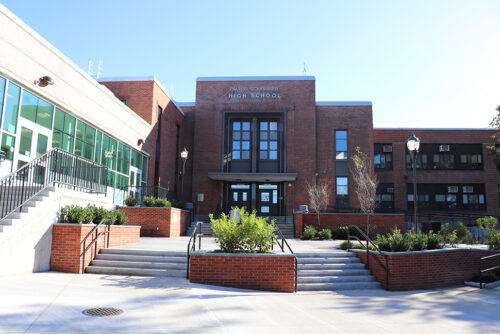
Mayor Guarnieri continued, adding, "Nevertheless, we are pleased that we have been advised about this removal and we will insist that the LIRR explicitly follow the federal and New York environmental protection laws by taking every measure to protect the health and welfare of our residents, especially since a public school resides within 100 yards of the substation."
Mayor Guarnieri is confident the removal will be done safely and without incident. "It is better the LIRR remove this material than to let it linger in our community. While we are willing to work with the LIRR to minimize the impact and eliminate any harmful influences, we also call upon them to keep the lines of communication open, as well as to have an MTA police presence while operations are ongoing."
The mayor, who informed the village's first responders, along with Deputy Mayor Kevin Greene, who heads Floral Park's Emergency Management Committee, added, "We also view the contaminated soil on this site as a red flag in terms of the construction of the proposed third track since there will be massive disturbance and excavation all along the mainline corridor.
"Once again, I am confident in terms of this particular remedial action work plan, that with our involvement all the necessary precautions will be taken and our village and its residents will be protected."
By way of background, the LIRR built, owned and operated substations throughout Long Island dating back to the early 1930s. Until the 1980s, the substations housed mercury rectifiers - devices used to supply power to LIRR locomotives and electric passenger car fleets, according to the NYSDEC fact sheet.
During the 1980s, the mercury rectifiers were removed from the substations and replaced with non-mercury containing solid-state equipment. However, past work practices employed during the operation and maintenance of the mercury rectifiers have affected the site.
The on-site building is an approximately 1,700 square foot one-story brick structure. Adjacent to the structure there is a 5,400 square foot transformer yard. The structure and transformer yard are between the Hempstead and Port Jefferson railroad tracks west of Plainfield Avenue, the fact sheet continued.
Back in 2005, Floral Park officials were notified of the contamination and plans to schedule field work to investigate the nature and extent of soil and groundwater contamination at a total of 17 LIRR substations, including the one in Floral Park and others in Little Neck, Queens; Mineola; Garden City (Nassau Boulevard) and Port Washington. A limited mercury cleanup was conducted within and soil was removed but these interim measures reduced exposure to mercury but did not eliminate contamination from the site. Mayor Guarnieri said that for ages, Floral Park had been pleading for the LIRR to clean their station in Floral Park and neighboring Bellerose.
The LIRR's clean up is being implemented under the provisions of the Voluntary Cleanup Program (VCP), which was established in New York to address the environmental, legal and financial barriers that often hinder the redevelopment and reuse of contaminated properties, according to the NYSDEC. The Voluntary Cleanup Agreement signed by the NYSDEC and the LIRR went into effect in November 2004.
Assemblyman Tom Alfano thinks it's about time these sites get cleaned up. "The bottom line is that these soils are contaminated and the people of Floral Park have to be protected. The cleanup starts this summer and will entail the removal of all contaminated earth. I will be watching this process very carefully and will demand that all community concerns are addressed in a straightforward manner by DEC and LIRR. The community will be respected in this process and I will make sure that their voice is heard."
The assemblyman urged residents to take advantage of the 30-day comment period, which expires May 23, noting that citizen participation has had significant impact on the cleanup programs. "I encourage the entire community to make their voices heard in this process," he said.
Written comments can be sent to Nathan E. Putnam, project manager, NYSDEC 11th Floor, 625 Broadway, Albany, NY 12233-7015 (518-402-9621). All health-related concerns can be sent to Scarlett Messier, public health specialist, NYSDOH, Flanigan Square, 547 River Street, Troy, NY 12180 (1-800-458-1158).