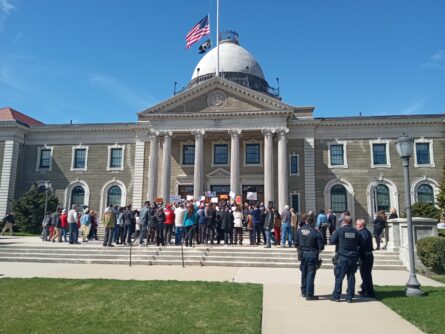
As some of you are aware, the MTA/LIRR has quietly reopened the public commenting period, which expired Aug. 31. It is interesting that they waited more than six weeks after the initial closing to spring upon the public its intention to permit additional comments concerning its scoping document, to be considered during the preparation of the Draft Environmental Impact Statement.
During the first commenting period, opposition was overwhelming, resulting in mostly standing room only crowds during the six public hearings. We can only surmise that the MTA/LIRR is making a belated effort to get more supportive commentary from special interest groups (none of whom live in communities affected by the so-called proposed third rail) to offset the overwhelming negative public reaction it received from the first commenting period.
As a result the village board has extended another open invitation to President James Dermody to come to Floral Park and answer the burning questions that were left unanswered during the last commenting period. This meeting is open to the entire community Wednesday, Dec. 14, at Floral Park Village Hall and will be held with or without Mr. Dermody.
Your participation is needed more than ever since the passing of the statewide transportation bond act this past Nov. 8 gives credibility to our theory that freight traffic is the real motive for the project. The bond act included a $40 million budget for the development of an inter-modal freight facility in Brentwood on the grounds of the former Pilgrim State facility. Rail access on this site is provided on the Main Line, which is the line targeted for the expansion. Hmmm... it hardly takes "homeland security" to connect the dots for this plot. I will have more on this in due course.
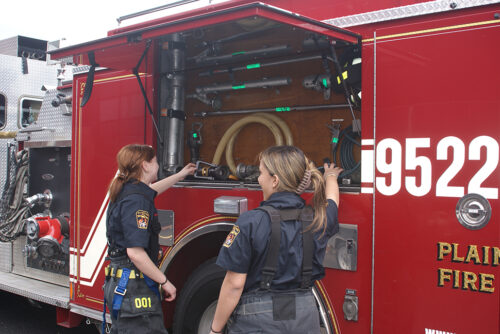
Deputy Mayor Kevin Greene and Trustees Tom Tweedy and Jim Rhatigan joined with me at Hofstra Stadium to cheer on the Floral Park Memorial football team who was participating in the Conference Championship against Plainedge High School. Out there on the gridiron playing their hearts out was the best team Floral Park has fielded in years. It was incredibly exciting as the Floral Park Knights took an early lead by scoring a touchdown. In the end the game really could have gone either way. A field goal by Plainedge in overtime ended the drama in their favor. But our team did themselves proud and made their hundreds of fans proud that such an outstanding and talented group of young men showed what school spirit, sportsmanship, a competitive spirit and personal courage is all about.
The village board is planning on a major reconstruction of Magnolia Avenue in the spring of 2006. By village standards it is a huge undertaking that will not only require the construction of a much-needed new road but a drainage system to rectify persistent ponding conditions in the area, as well as curbing. It appears that a number of trees will have to come down and new trees replanted. The village board has been working diligently with our village engineer and an arborist to save as many trees as possible. Last year our village planted 130 trees; this year we will plant a similar number of trees. We've been awarded the Tree USA award and our feelings about these leafy giants embody all the sentiment of Joyce Kilmer's famous poem about trees. It is not always easy, however, to reconcile the mathematics of engineering principle with the lofty aspirations of poetic expressions. As a result some trees will have to come down.
Nevertheless, the village board invited all the residents of Magnolia Avenue to a public meeting Nov. 30 to discuss all the details of this proposed project. A public meeting for a road construction project was unprecedented but the village board felt strongly that leadership is not just about issuing directives, but it's about listening, understanding and working together to develop a consensual and realistic plan. I must commend Deputy Mayor Kevin Greene who was conscientiously assisted by Trustee Jim Rhatigan in their tireless efforts to meet with Magnolia residents, understand their needs and concerns and work to come to as mutually a happy conclusion as they possibly can.
There is chatter everywhere that we are in for a flu epidemic of 1918 proportions. That year some 500,000 Americans died and perhaps as many as 50 million worldwide, far exceeding the total number of deaths in WWI, which had begun in 1914 and was still raging in 1918, the final year of what was called, believe it or not, the war to end all wars. Obviously, one more prediction from the so-called experts that went wildly awry of the mark.
Similarly, there are predictions percolating everywhere about death tolls reaching one million in the United States when up to now just 60 people have died from the flu and none have been in the United States. Moreover, the victims are virtually all bird farmers and have occurred in countries with medical systems that are literally primitive compared to our own. Also, all infections have occurred because of direct contact with infected birds. There is no case where the Avian flu has passed from human to human, which is the only way that the flu can reach epidemic proportions.
Notwithstanding these reassuring facts, our administration has been in contact with officials at the Center of Disease Control and Prevention, Nassau County Health Department and other local medical authorities to make certain we are fully informed on what precautions we could take, what to look for and who to contact in the event of anything that appears even mildly suspicious. We intend to do everything in our power to protect our residents from any unwanted intrusion whether the culprit be freight or flu while recognizing the all-important distinction between keeping the public informed and creating an unwarranted panic. Right now, quite candidly, there is a greater health risk for elevated blood pressure worrying about the Avian flu than the flu itself.
All this is not to say that a pandemic (worldwide epidemic) cannot happen. It happened three times this century: The Asian flu of 1957-1958, the Hong Kong flu of 1968-1969 and of course the infamously deadly Spanish flu of 1918-1919, which was the last one that was truly catastrophic. Meanwhile, the record is rife with predictions of impending pandemics that never happened: The Swine Flu of 1976 was projected to kill one million Americans but overshot its mark by 999,999 deaths (many dozens had actually died from taking the vaccine to prevent it). In 1997 the Hong Kong Bird Flu was supposed to be the next big one until it quickly fizzled out with a worldwide death toll of six. Finally, let us not forget the outbreak of SARS (severe acute respiratory syndrome) in 2002 that resulted in 71 cases and not a single death in the United States. SARS obviously did not, as CNN repeatedly warned it would, overwhelm the US Health Care System.
These examples show not that a pandemic cannot happen again only that no one really knows when or where. This village administration is working to be prepared to deal with any exigency or extremity but it will do so based on facts not fear, on reason not rumor and on hard science not scare mongering. What we can say with confidence about the Avian Flu (which is different from the usual strains of flu that reach US shores every year claiming an average of 36,000 lives) is as follows:
It remains localized in places like Cambodia, Indonesia, Thailand and Vietnam where even with antiquated medical facilities the latest death toll count is 64. Of these cases all are a result of a massive exposure to infected birds - again infecting bird farmers. Thus far there is no evidence that this flu has been transferred from one human being to another. While it is true that migratory birds can carry it to another part of the country or even another continent there is no indication whatsoever that this has occurred although we are informed that the authorities are vigilantly on the lookout for such an event.
There is no such thing that we are now overdue for another pandemic. Any notion of a timetable or cyclical occurrence is rooted more in superstition than scientific fact. Furthermore, no one knows when or if the Avian flu could randomly mutate to be transmissible between humans. All we know is that so far it hasn't.
While there are holes and lapses in every public health care policy our resources to bring the disease under localized control (if there is a breakout) is greater than ever. The marvels of modern medical science continue its march of progress to, in the words of the philosopher Francis Bacon, "relieve the estate of man." Most virologists agree that today's antibiotic and antibacterial vaccines can be marshaled to prevent deaths caused by secondary infections and since most strains of flu do not kill people directly this optimism is quietly reassuring.
All of this, however, is on a macro-scale. It is up to us to take a commonsense approach to keep ourselves healthy. Obviously don't handle any wild birds, make sure you wash your hands frequently with soap and hot water and yes, even alcohol will help. Make sure you keep your immune system strong by maintaining a good diet, avoiding or minimizing stress whenever possible and getting enough sleep. Also make sure you get an annual flu shot to reduce the chances you'll be fighting two strains of flu at once.
As for your village government, be assured we will continue to be in contact with all the relevant agencies monitoring the latest updates and instruction. These matters must be taken seriously even when viewed through the prism of perspective. It is our philosophy that an ounce of precaution is worth a pound in gold. At the same time we must never allow fear, uncalled for and unreasonable fear, to ruthlessly seize the scepter from reason and rob us of all the joys and blessing this holiday season can offer us.