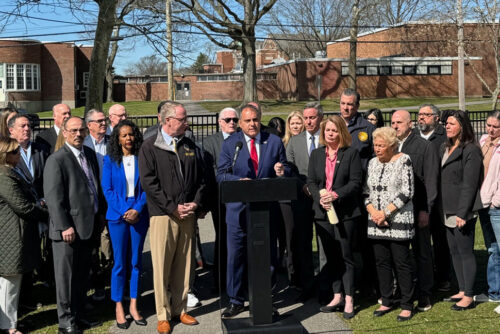
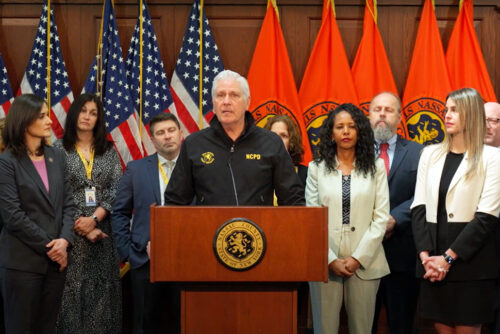
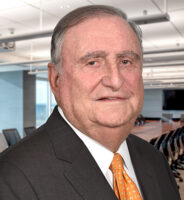
"For Nassau County to be sustainable into the next generation and beyond, we must attract young college graduates and businesses to locate here...We need to create 'cool downtowns' in Nassau where commercial areas are located near transportation centers and where housing, mixed-use structures and local amenities can be sited to support walkable communities." With this declaration, Nassau County Executive Thomas R. Suozzi hosted a forum in Rockville Centre on June 5, attended by hundreds of business, civic and community leaders, in addition to a panel of elected officials from across the county, to address the issue of the revitalization of the oldest suburb in America.
|
|
County Executive Thomas R. Suozzi describes his vision for the future of the downtowns of Nassau County's towns, cities and villages.
|
The county executive has been touting the need for vital and dynamic downtowns, thereby "recycling and reusing property" for some time. At the Creating Cool Downtowns conference, Suozzi said he was fulfilling a promise made in his March State of the County speech to forward the economic benefits of cool downtowns. His reasoning in presenting an open forum for information and dialogue among the county's municipalities was simple. "The best way to get where you're going is to know where you want to be," he said.
The panel was scheduled to include Nassau's three elected town supervisors, Hempstead Town Supervisor Kate Murray, North Hempstead Town Supervisor Jon Kaiman and Oyster Bay Town Supervisor John Venditto. Supervisors Murray and Venditto were unable to attend, but sent representatives in their stead, Hempstead Councilwoman Dorothy Goosby and Commissioner of Planning and Development for the Town of Oyster Bay Jack Libert, respectively.
Mayor Jean Celender of Great Neck Plaza, Mayor Peter Bee of Garden City, Mayor Ernest Strada of Westbury, Councilman Leonard Remo of Long Beach, Councilman Edward Ambrosino of Hempstead and Glen Cove BID Executive Director Francine Ferrante were on hand to participate in panel discussions and a Q and A, followed by a walking tour of Rockville Centre's downtown.
At the forum, the county executive defined four types of downtowns he envisions in the maturing suburb of Nassau.
Cool Downtowns, with a major purpose of expanding the tax base, would consist of a mixed-use environment with residents living and working in multi-story buildings, be located near transportation and within walking distance of shops and restaurants, and offer a cultural, diverse and educational environment to attract young people and empty nesters. Suozzi cited the Village of Great Neck Plaza, Rockville Centre, Garden City and the City of Long Beach as examples of cool downtowns, with Westbury, the City of Glen Cove and Mineola on the way.
Quaint/Historic Downtowns are more low-scale and walkable, Suozzi said, and serve the local area with a retail component and off-street parking. They present a cohesiveness and identity that is describable and unique. Quaint downtowns include Roslyn, Island Park and Bellmore.
Potentially Cool Downtowns, said the county executive, include Port Washington, Valley Stream, Lynbrook, Syosset, Baldwin and Farmingdale. As yet, Suozzi added, these municipalities have not expressed an interest in becoming "cool," but, he believes, have untapped potential. Under the heading of Should Be Cool, Suozzi included the Village of Freeport, Village of Hempstead, Elmont, Town of Hempstead, Hicksville and the Town of Oyster Bay.
Farmingdale Village Mayor George "Butch" Starkie said "the people of Farmingdale are miles ahead of many of the almost cool downtowns."
"Farmingdale has completed a visioning plan that the community funded itself. This upsets me because there are all kinds of grants available for visioning now which were not available to us," Starkie added.
Farmingdale Village is holding their first public hearing to consider changing the zone in the downtown district and near the railroad station to permit Mixed Use development, housing over retail space, on July 7 at 8 p.m. at Village Hall.
Starkie said he would like to complete an independent, comprehensive study on changing the village code to allow Mixed Use, however the cost would be upwards of $250,000.
"This is where we need help," Starkie added. "All the groups and organizations that are proponents of this kind of development come to these meetings but they never bring their checkbooks with them. We have had offers from developers to fund the study but the results would be suspect. The county executive has kept his word and his staff has been in touch with me and we have additional meetings scheduled to work on funding sources."
The village has also reached out to Senator Kemp Hannon's office and was informed that he is working on grants and other sources to fund the study.
Auto-Oriented Commercial Centers, said Suozzi, include municipalities such as Levittown, East Meadow, Plainview and Greenvale. Their retail districts consist of strips located along major roadways and are not walkable communities, although they do provide many of the same services as a central downtown, albeit with a different approach. Shops and services in these centers want passers-by to see the establishment from their cars, pull in, shop, and go.
The county, said Suozzi, has room for many types of central shopping and service areas; not all downtowns, he said, can be cool and "one size does not fit all."
Cool downtowns are becoming more welcoming to residents and visitors with streetscapes, seating areas, Victorian lighting, and more restaurants serving alfresco (perfect with spring and summer upon us), as well as cultural and civic events and activities. Art shops with lighted windows and boutiques that present their wares for window-shopping after-hours add to the walkability of a downtown in the evening, and offer the promise of a return trip for a purchase during the day. A downtown needs to be a destination, with specific offerings.
Suozzi made it clear that, while the idea of cool downtowns is being examined countywide, individual municipalities will be responsible for zoning laws and changes, and be able to design a downtown to suit its character. "There aren't Mom and Pop stores the way there used to be," he said, "but there are entrepreneurs that offer services and specialty items that the 'big box' stores, or mall stores, won't give you. Those can fit nicely into a vibrant downtown."
Results will depend largely on the "Three Cs," said Suozzi: commitment, community and cooperation. Then come the funds. Once a working vision is established, municipalities can seek grants on a county, state and federal level. A solidified plan will also attract businesspersons and developers, who could help a town find the right balance of design for its desired effect. Acknowledging that the word "developer" is often conceived as negative, Suozzi emphasized that if a community finds a developer who understands its vision, the relationship can result in success. Another fear Suozzi said he has heard in regard to his vision is that of "Queensification." That will not be the outcome of the creation of revitalized downtowns, he said.
The downtown is often the main focus of a municipality. "If someone travels through and sees an empty downtown, that's the image they retain," he said, adding that they can't see the homes and schools that may be doing just fine in other neighborhoods of the city or village.
The formation of Business Improvement Districts (BIDs) is an aid to creating vibrant downtowns. BIDs are public/private partnerships in which property owners and businesses work together with a desire to balance residential and business structures in a downtown area and invest in making the area more attractive, safe and an all-around desirable destination. Very often BIDs are responsible for holiday decorations and events, outdoor summer entertainment and children's activities.
County Executive Suozzi invited elected officials, community and civic leaders, businesspersons and residents to contact him with any ideas or questions they may have to enhance the concepts presented at the forum.
In between sessions of the conference, the sound system at the St. Agnes Parish Center played a Petula Clark tune from the '60s, Downtown, and the thought that "everything's waiting for you..." might have made the concept of cool downtowns a bit cooler to those of a certain age.
(Jaime L. Tomeo contributed to this story.)