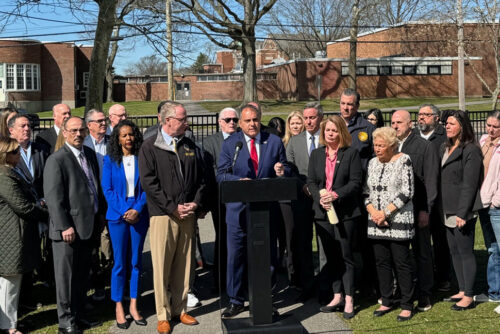
New York State Assemblyman Rob Walker (R-Hicksville, 15th District) along with members of the Nassau County Assembly Republican delegation held a roundtable discussion May 19 that touched upon what had become an extremely popular issue these days - property tax relief for Long Island residents. The Assembly Republican Steering Committee sponsored the event, which took place at the Farmingdale Public Library and is part of a series of roundtable events being held throughout New York State.
"The average homeowner on Long Island pays close to $10,000 in property taxes," Walker said in a statement. "It's unacceptable that residents of Long Island pay more than twice the statewide average. While the importance of education and infrastructure cannot be underestimated, our residents need real relief now."
One way Walker said the Assembly Republican Conference anticipates bringing additional savings to New York residents is through the "Saving Our Homes" plan. Under the plan, which makes enhancements to the School Tax Relief program (STAR), a program set up by Governor George E. Pataki that provides a partial exemption from school property taxes, would result in an additional average savings of $1,483 for Nassau County senior citizens and $1,019 for non-senior homeowners.
According to the Office of Real Property Services website, the Basic STAR program works by exempting the first $30,000 of the full value of a home from school taxes. The Enhanced STAR program is for senior citizens age 65 and older that exempts the first $50,000 of the full value of their home from school property taxes.
Assemblyman James Conte (R-Huntington Station, 10th District) said that the STAR program is being eaten away by inflation and enhancements to the program need to be conducted over and over again. "We need to have what we call the CO-STAR program, which is a county STAR tax program which would help out county taxpayers and meet the obligations of the counties," said Conte, adding that last year the state legislature capped the Medicaid portion for the counties which paid 25 percent of the Medicaid bill and it continues again this year. Ideally, the goal is to cap the Medicaid portion of the local real property taxes on the county level, but if that is not feasible, "we have to come up with ways to reduce waste and reduce fraud ... specifically the major providers of health care," Conte said.
"Medicaid is a $113 billion budget that we have set for the coming year," said Assemblyman Joseph Saladino (R-Massapequa, 12th District). "The cost of Medicaid to the state is nearly half of that budget. So saving on abuse and fraud of the Medicaid system will make a difference."
Once the discussion opened up to the floor, many issues that concerned attendees dealt with ways to keep young people and seniors on Long Island, affordable housing and state aid for school districts.
As taxes increase and the price of homes boost from year to year, young people and senior citizens are having a hard time remaining on Long Island.
"We don't need more million dollar homes," said Carol Meschkow, president of the Concerned Citizens of the Plainview-Old Bethpage Community, Inc. "We need homes for the young people, the seniors who are retiring."
Walker discussed a grant program that he is sponsoring that would purchase homes for the first-time homebuyers and spread it among towns on Long Island. The grant would give tax credits to business firms which contribute to not-for-profit housing companies. According to the assemblyman, the DiNapoli/Balboni Bill that passed in the Assembly this year is another great start to keeping residents on Long Island. The bill states that developers must put aside 10 percent of their units (5 or more units required) as affordable housing. Walker added that the bill goes side by side with his proposed housing bill that states that 10 percent to 15 percent of development would go toward affordable housing or into a fund created specifically for future development solely for next generation, workforce and senior citizen housing.
However, even though Meschkow agreed that the DiNapoli/Balboni bill was a start, she stressed that young people don't want to stick out in affordable housing complexes. "We want it to blend like a Levittown. That's really what the young people want. They don't want to be different," she said.
The State of New York Mortgage Agency (SONYMA) has programs that aid first-time homebuyers by offering low interest financing and down-payments on mortgages that could help keep young people on Long Island. "It's important for us to let people know about these programs so that they are available [to those who are unaware of the programs]," he said.
Providing homes for the next generation, work force and seniors has its pros, but Conte said building problems might make it difficult. He said the builder's biggest cost is land and in order to provide that type of housing, it would have to exceed two stories.
"When they [builders] look at whether they are going to build a $200,000 affordable home or an $800,000 luxury home, they are going to make more money and get an income if they build the $800,000 home," said Conte, adding that past generations made the decision not to build skyward and, in order to make the housing available, the assembly would have to discuss if they decide to build, where the appropriate locations would be.
But Walker said that if affordable housing is in the works, it must be spread out throughout the towns so that it doesn't become an isolated area where everyone's children attend the same schools and overcrowding becomes an issue.
When asked what steps young people should take in order to find a solution that would allow them to remain on Long Island, Walker said the number one step to take is to get involved. He said there are not enough young people voting and many do not understand the process. He recommends they talk to their assembly, state senators and local townships that will help them with the issue and discuss affordable housing plans in depth.
To keep seniors from moving out-of-state where homes are more affordable, Conte said there is a proposal floating in the assembly that would cap the school portion of the real property taxes for anyone over 70 years of age. However, it was not included in this year's budget, but Conte said seniors should continue to talk to their legislator about it.
"The senior citizens built our state and built our counties and built our towns," Walker, a lifelong resident of Hicksville, said, "We want to keep them here."
However, Saladino believes the price of education and taxes is what's driving out the young people and seniors. "We really need a reform of our school funding system," he said.
Those Long Islanders, who already are homeowners, are being punished for trying to improve their homes, provide jobs to contractors, and in essence are being thrown out of their homes because taxes are through the roof.
"We are so frustrated because look at a $500, 000 home here in Massapequa or Farmingdale and a $500,000 home in Brooklyn or Queens. Look at their tax bill," said Saladino. "Talk about inequity. Where ours is $8,000 or $10,000 thousand a year, theirs is $1,200 or $1,500 a year. We are clearly unbalanced."
This year, according to Saladino, the Assembly tried passing a real property tax rebate to Long Islanders and homeowners throughout New York State but the governor vetoed it. The legislature overrode the veto and now the proposal sits between the legislature and the governor. If it passes, it would provide $1.8 billion worth of direct real property tax relief to homeowners. Saladino said Nassau and Suffolk counties were going to get the bulk of it.
Rosemary Stein of Plainedge asked the delegation why there was a 10.5 increase in state aid for Plainedge School District when there are three assistants to the superintendent and the addition of a new middle school.
Saladino added, "I don't think it's enough state aid. The school boards handle the budgets of the school. All we are in power to do is to come up with a consensus of how we will bring state aid to the schools. What we have not done ... is send them a very clear message that we want it done within the boundaries of what we can afford."
However, some districts, such as the Village of Westbury do not receive the state aid that they feel is necessary to operate with because they are considered wealthy by the state.
"We are perceived as a wealthy district and because we have Old Westbury in our district, it brings the amount of state aid down considerably," said Westbury Village Deputy Mayor Joan Boes. "We are inundated now with the overflow of new immigrants who do not live in Old Westbury, who don't live in the the Village of Westbury, but live in an unincorporated area called New Cassel."
Boes said the district's philosophy has become "I don't care if they live in a car, they will be educated in the Westbury School District." She said they still get counted as a rich district and the state aid formula doesn't work in her case.
Saladino said he is sponsoring a bill that would set a regional cost index so that schools, where it is expensive to operate, the State Aid formula would reflect it, resulting in more state aid.
"It's time to revamp the system," said Saladino. "It's time we reach out to school budget members en masse, to let them know we want a very good education for our students but we want it done in a method that creates a balance."