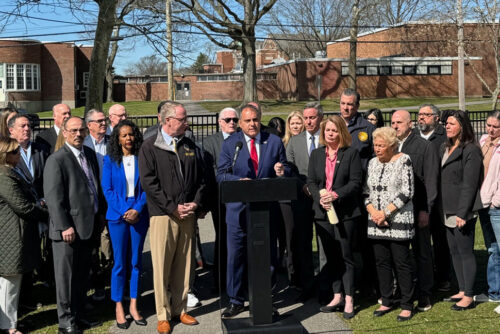
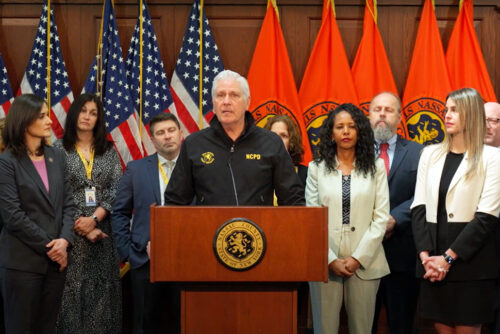
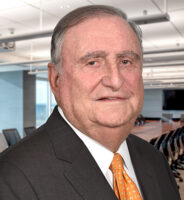
Dr. Jonathan C. Gibralter, seventh president of SUNY Farmingdale, celebrated with his family, friends, school administrators, faculty and staff last Friday at his inauguration ceremony held on the campus in Nold Hall.
|
|
Dr. Gibralter being officially installed as president by SUNY Chancellor Robert L. King.
|
Present on the campus since early this summer, Dr. Gibralter is looking toward the future hoping to spread the word about the school, improve and expand courses offered and make SUNY Farmingdale the best school possible.
"At the point when I applied for the presidency at Farmingdale, I was also in the running for several other presidencies. I grew up on LI, I knew of Farmingdale and through the interview process when I had an opportunity to see the campus and meet people; with the search committee, chancellor and his staff; I felt that Farmingdale was the greatest opportunity for me," he said. "I felt that the opportunity to take a college that was in the middle of an enormous transition from a two year college of agriculture to a four year college of applied science and technology was an incredible opportunity." Dr. Gibralter added that he saw taking the position at SUNY Farmingdale as a great opportunity to lead the institution into the 21st Century.
Prior to coming to SUNY Farmingdale, Dr. Gibralter waas interim president at Corning Community College, serving as academic dean at the school for two years. He has had a career in higher education for over 16 years, starting on the faculty at Morrisville.
"I've been made to feel so welcome here, the people are just really terrific," Dr. Gibralter said of how he's been treated at the school. "It's like I have a new family."
Dr. Gibralter acknowledged that several challenges do lie ahead not just for him as a new president, but for the university as a whole. He noted that coming in as a new president in itself is a challenge, since the last president served for 22 years. In addition, the college's transition of going from a two year school of agriculture to being the four year university it is today, is a challenge.
"The greatest challenge was helping us steer a course ahead because I think people were so focused on the way things have been," he said. "People welcomed having someone who would get them out of that long transition period and move the institution ahead. One of the greatest challenges ahead of us right now is [taking] a college that used to be a two year college of agriculture and raise its prestige. [Another] challenge is getting the word out to our communities that we're here and that we're not the old SUNY Farmingdale, but at the same time doing it in a way that isn't disrespectful of the old SUNY Farmingdale, because the old SUNY Farmingdale is a pretty neat place," he said.
SUNY Farmingdale, the oldest public college on Long Island, is in the midst of creating a comprehensive strategic plan, mapping out the school's future.
"We have a Strategic Planning Committee consisting of at least 40 people who are working hard to develop an environmental scan to get a sense of who we are right now and also doing an analysis of what are our strengths and weaknesses," Dr. Gibralter explained, "who are we going to be; what kind of an institution are we going to become. The real challenge in that is to identify the resources necessary to help us realize our vision."
Dr. Gibralter said that the university has been considered to be one of the best kept secrets on Long Island, another challenge it faces.
"We have 400 acres of land here, on the Route 110 corridor, with many businesses and industries right around us, sharing a marketing taskforce," he said. "What we want to do through that process is really get the word out as to who we are, then develop a new focus of what our new programs are going to be. I think the message overriding all of this is that Farmingdale is not a community college, but we are the community's college, we're Long Island's college. I really want people to know that we're here as a resource, we're here to try to meet their needs and that we have a history of being very flexible. We really want to become very involved in the communities in which this college resides," he said.
"We don't see why the majority of young people who graduate from all of our local high schools wouldn't come to Farmingdale; why would they go to a private university when we can guarantee them that their classes aren't going to be larger than 25 students, they're going to get a lot of individualized attention and they're going to get some of the best faculty in the state of New York. Why would they pay five times the amount when they could come here and get a very high quality education. That's really the overriding message."
Dr. Gibralter noted that over the next couple of years, the school will be putting up new residence halls, for which they have bonded $15 million.
"We want to make this a vibrant four year university. Over the next couple of years, Farmingdale is going to be the up and coming college and we're going to have a major impact on Long Island, the way we had a major impact on the agrarian economy of Long Island, we're going to have a major impact on the technological economy of Long Island," he said.
He added that while the school has been successful in the past, noting its fabulous graduate success stories, he strives to make it even better.
"One of the things that makes Farmingdale very unique is that we have a series of centers on campus [through which] students get more applied opportunities," he said, noting that the school has a solar energy center, center for applied mathematics, advanced pavement studies, institute for manufacturing research, and is hoping to have a center for biomedical research and possibly a center for transportation security, focusing on protective services. In addition, he noted the new media design center, the school's on campus graphic communications studio where students actually do contract work with local business and industry (currently just non profits).
Dr. Gibralter added that in addition to the centers and institutes available to students, the school houses the most beautiful horticulture gardens he has ever seen. "A lot of people probably don't even know that those gardens exist," he said, adding that all those things combined make SUNY Farmingdale a great college, one that many may not know about.
Dr. Gibralter's inauguration was the first at the college in 23 years. More than 15 visiting college professors attended the ceremony. Others who attended the ceremony included Rabbi Marc Gellman, who offered an invocation, Senator Charles J. Fuschillo Jr., Assemblyman Steve Labriola, Farmingdale Village Mayor Joseph Trudden, Village Trustees Marialyce Denauski and Vincent Sotis, Deputy Mayor Dr. Benjamin Giminaro and several Suffolk officials.
After being introduced by SUNY Trustee Hon. Louis Howard; State University of New York Chancellor Robert L. King presented Dr. Gibralter with a medallion and officially installed him as president of the university.
"I am delighted to be here in Farmingdale for this absolutely wonderful occasion," King said. "As some of you know, there was a lengthy and at times difficult search process and I am thrilled that the search committee came to a conclusion that has brought us here today. [Dr.] Gibralter comes to this college armed with not just the real life experience, but a lifetime of commitment to education and to students, to his work. He is a teacher and a leader."
King noted that the SUNY system has certainly grown, and that the Farmingdale campus reflects that growth. "I think the reason more students are choosing to come to this university is because increasing numbers of people in our state are recognizing the quality that is here, the quality that is reflected in the day-to-day work of our faculty and our administrators and our great new president," he said.
King, who was just starting as chancellor while the search process at Farmingdale began, added "The thing that struck me about Farmingdale was that here is this gem of a college, located in the heart of one of the most robust and important industrial areas of our country; there is more great science and great business growing out of [this area] and this part of our state needs the very best in terms of academic resources. These companies cannot grow and cannot succeed if they don't have the people with the education and skills to allow that to happen. It is our responsibility, first and foremost, to make sure that we have those resources in place because it is through their success that the economy of this region and state will prosper," he said.
King noted that the bioscience center, through the foresight of the several local politicians who were sitting in the front row at the ceremony, will help the college accomplish that mission.
"In the Rabbi's invocation, he talked about how important what we do is, not just to make smarter people but to make people who are truly good," he said. "That happens here everyday."
King added that Dr. Gibralter will help move the college along. "To lead us into this new century, you have collectively selected this very bright and talented and energetic young man. He is a person who has distinguished himself in his previous experience, volunteering to assist the development of an array of efforts that are improving the entire quality of education across New York State. He will bring new energy, focus and direction to this new century and will continue to march for Farmingdale," he said.
Following his official installation as president, Dr. Gibralter thanked everybody in attendance for joining him at the ceremony, as they celebrated the beginning of a new era for SUNY Farmingdale.
"This occasion takes on a special meaning for me, as I'm able to celebrate it with my family," he said. In addition, Dr. Gibralter thanked his seventh-grade English teacher, the first teacher he ever had "who made learning the labor of love," for joining him.
"We are here to redefine SUNY Farmingdale as New York's premiere four year college held in the same national regard as colleges like Rochester Institute of Technology. It's important we provide students with tools necessary to compete in today's world," he said. Dr. Gibralter added that technology is not the only focus of the school, noting that he has spent the past several months speaking with industry leaders to see what they need from college graduates, in an effort to provide necessary programs to SUNY Farmingdale students.
"I've found that technological programs cannot exist in it of themselves on college campuses," he said, "I also believe it is our responsibility to develop educated and politically concerned citizens. Our students will not only understand technology but the implications for their communities and the nation during a period of rapid transition and uncertainty. With your assistance, we will find a correct balance of programs for the college of technology in Farmingdale," he said.
"The good news is that a dedicated group of faculty and staff are already engaged in the process of developing our strategic plan. This plan will drive our vision to the future. It will provide a road map that will make clear both where we are going and how we intend to get there. If the college of technology at Farmingdale is to fulfill its mission to become a premiere college, it will need a solid endowment. We need to be able to support student scholarship, restore our historic buildings and create opportunities for our faculty while providing our students with the best possible education. There will be so much benefit to be derived from our campaign. The success of our college may ultimately be judged on the basis of how effectively we continue to educate the next generation," he said.
"We will continue to create an atmosphere where our faculty and staff can truly excel; where scholarship, inspired teaching and creativity are valued and where students are at the center of our decision making."
Dr. Gibralter added that students are the main reason for the college's existence. "It is our goal that you will experience a community that supports your education while it enhances your life. A college president must embody a school's finest aspirations and goals. Through leadership and example, the senior administration will serve as a catalyst in transforming our school into a community and will keep us focused on our mission," he said. "We will face this challenge as a single educational community loyal to its traditions. I'm grateful for the opportunity to serve this community as the seventh president of this outstanding institution."