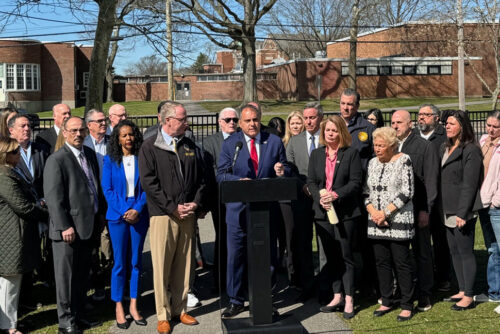
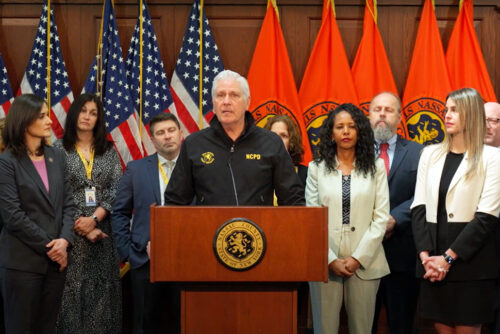
Following through on a commitment that has helped make Long Island a world contender in the biotech industry, Senator Charles. J. Fuschillo Jr. was recently joined by his Senate colleagues from Long Island to announce his recommendation for $30 million to be allocated in the Senate Budget Resolution for a "Gen*NY*sis Center of Excellence" on Long Island to continue economic growth in the fields of biotechnology and biomedical research. The proposed center would be a consortium to include, but not limited to, SUNY Farmingdale, SUNY Stony Brook, Cold Spring Harbor Laboratory, and Brookhaven National Labs.
"Rapid advances in the life science fields have made biotechnology and biomedical research an opportunity for economic development and job creation," Fuschillo said. "The creation of 'Gen*NY*sis Center for Excellence' on Long Island would capitalize on a partnership among our local colleges and private research institutions that are already doing work in the area of life sciences. It will also help create jobs and pump hundreds of millions of dollars into our economy."
The Gen*NY*sis (Generating Employment Through New York Science) program, would encourage biotech job growth through a mix of state and federal grants, industry and academic funding; and additional targeted tax incentives to new companies launched by rapid advances in life sciences, genomics and genetics. It would also seek to build new ties between the industry and New York's world-class universities and research institutions.
"Gen*NY*sis is designed to put New York State at the forefront of a new and growing industry and form the basis of our economy in the future," Fuschillo said. "By locating a Gen*NY*sis Center for Excellence on Long Island, we will be able to build on the tremendous academic and economic base that we have established in the areas of biotech and high technology research."
Senator Fuschillo, a proven advocate for advancement of the biotech industry on Long Island has already helped create new private sector jobs and add millions of dollars to the Broadhollow Bioscience Park at SUNY Farmingdale. The Broadhollow Bioscience Park is a nonprofit organization consisting of joint-partnership between Cold Spring Harbor Laboratory and SUNY Farmingdale. Through Fuschillo's support, the new Bioscience Park, home to established and startup biotechnology companies, is anticipated to generate more than 1,000 private sector jobs and attract and/or retain new companies to the region.
The Gen*NY*sis Zone is one of eight that would be created throughout the state to be located near or within existing biotechnology research and development clusters. Biotech companies locating within the zones would be eligible for various tax incentives including an increase in the research and development tax credit to 20 percent, a doubling of the current qualified emerging technology wage and capital credits of biotechnology companies and removal of the alternative minimum tax limitation on emerging biotechnology companies.
"The cutting edge research being done at college on Long Island and at private research institutions is very exciting," Fuschillo said. "This program gives us the opportunity to make our area one of the nationwide leaders in biotechnology."
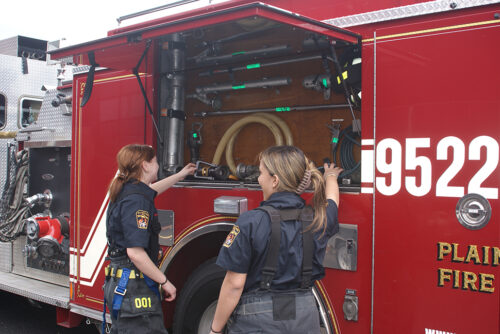
Senator Fuschillo recently unveiled a plan to boost the ranks of firefighter and ambulance volunteers on Long Island and across the state by offering free college tuition to new recruits.
The plan also seeks to improve safety and readiness of the state's volunteer fire and ambulance corps by reviving the state's "Emergency Services Revolving Loan Fund" with $4 million in new funding to aid the purchase of state of the art fire fighting equipment, fire trucks and ambulances, protective devices and to upgrade fire stations.
The plan, part of the Senate's budget resolution approved recently, provides $2.5 million to pay up to the level of SUNY or CUNY college tuition - up to $3,400 a year that could be used at any college in New York. To be eligible, volunteers must have served at least one year and continue to be active while attending school. It is estimated that up to 1,500 volunteers could benefit each year under the program
"Senator Fuschillo's plan is a grand slam for volunteer fire service, volunteer ambulance corps, college students and the residents of the state who have relied on these services for hundreds of years," said Chief John M. Fabian, Merrick Volunteer Fire Department. "This incentive will be sure to increase the ranks of both services, while educating the youth of our state. I applaud Senator Fuschillo and his Senate colleagues for taking the bold step in helping to continue the tradition of the volunteer fire service for years to come."
"Volunteers are the lifeblood of fire department and emergency service corps throughout Long Island and the state," Fuschillo said. "This plan also included a financial incentive to ensure a steady supply of volunteers are available with the best fire fighting equipment to save lives and protect property when emergencies occur."
Nationally, the number of volunteer firefighters has declined 10 percent over the past 20 years, while the number of calls to volunteer fire companies rose 50 percent or more. In NYS, the number of volunteers has dropped by at least 11,000 over the past three to five years, to 109,000, according to Jim Williams, president of the Fire Association of the State of New York, a coalition of 2,000 volunteer fire and emergency services companies across the state.
"This plan provides the type of proven recruitment that will help departments meet the demand for qualified, dedicated recruits to serve their communities," Fuschillo said. "A college education will help the volunteers not just in their personal lives, but will also help encourage them to become better members of their emergency service corps and their community."
In addition to the free collage program, the plan also includes funds to purchase life-saving thermal imaging cameras for fire departments across the state. Thermal imaging cameras allow firefighters to peer through smoke and steam to detect heat sources, such as humans who may be trapped inside a burning room or building. The handheld devices, which cost as much as $25,000 apiece, also protect firefighters by making victim searches in dark, burning and unstable buildings quicker and more efficient, exposing them to fewer risks.
"This state of the art technology can save lives not just of fire victims, but also protect firefighters whose risky job often requires them to search throughout dangerously fire-damaged buildings to save lives," Fuschillo concluded.