With elections and budget deadlines looming, Nassau's Republican majority legislators last Thursday put forth a proposal to eliminate the county's multi-million dollar deficit - a plan which includes spending cuts, but also more taxes.
The proposal, known as the 1999 Republican Legislative Deficit Elimination Program, is a set of guidelines that the legislators want County Executive Thomas Gulotta to follow in preparing his fiscal year 2000 budget proposal, which he must submit this week. Estimating the structural deficit at $138 million, it calls for $40 million in spending cuts by trimming salaries of elected officials and department heads, as well as operating costs.
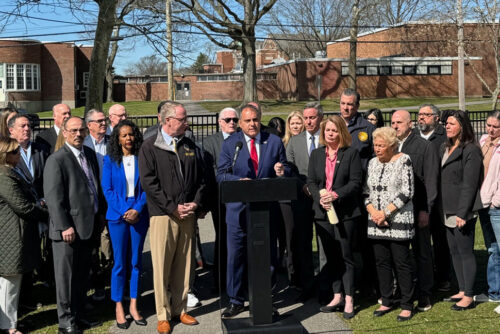
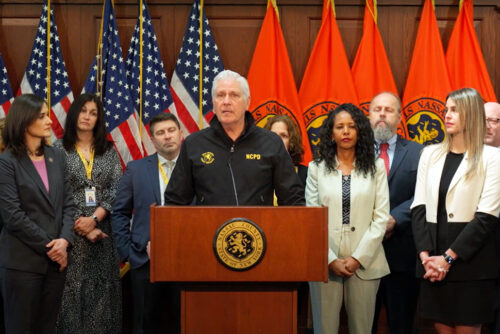
"The Republican Legislative Deficit Elimination Program will eliminate the Nassau County budget deficit and provide economic stability with bare bone budget cuts," said Bruce Blakeman (R, 7th L.D.), presiding officer of the Legislature, in announcing the plan.
However, it is unclear from where a third of the money in the program - an unspecified $35 million in new recurring revenue - will come. The Republican legislators are leaving the details up to Gulotta, and said only that they will review his proposal for generating the funds when he presents them next week.
And the controversial real property transfer tax, which was proposed by Gulotta and approved by the Legislature last month, accounts for $50 million of the plan. It charges homeowners 1 percent on the sale of their property, and had been opposed by many taxpayers. It was originally put in place for 18 months, but the Republican legislators said they plan to ask the county executive to lobby state lawmakers for an extension, so that they can count on the revenue for at least three more years.
The deficit elimination plan also anticipates at least $5 million in savings from the creation of an assessment review board aimed at reducing tax certiorari claims, and an extra $8 million from a Nassau Community College tax that would enable the elimination of the College Subsidy.
Blakeman said the plan has the backing of all 14 members of the Republican delegation, which represents a veto-proof majority, and that if the county executive does not follow the guidelines, they will not approve his budget.
The following would comprise the $40 million in cuts: trim elected officials' salaries by 5 percent until the fiscal crisis is over (except for the District Attorney and Assistant District Attorneys, due to concerns that this would present a conflict of interest, because these officials comprise an independent investigatory body); cut salaries of department heads and deputy commissioners by 5 percent, and as an incentive for responsible fiscal practices, those whose departments operate within their budgets will have their salaries restored; reduce legal and professional fees, as well as personal services contracts by at least 10 percent; salary freeze for all non-union personnel, until the fiscal crisis is over (except the DA and ADAs).
The program also intends to give the Legislature a greater role in fiscal oversight, through calling for spending cuts to be enforced by requiring department heads to come to the Legislature each month for money.
In an apparent effort to restore public confidence in their county officials, it places limitations elsewhere, as well. One-shot deals (the sale of government property to generate revenue) would be allowed only to reduce debt after the 1999 deficit has been erased.
"What we're not going to do is use one-shots as a mechanism to provide operating funds for the county," said Blakeman. "That's one of the reasons why we happen to be in the fiscal problems that we have now."
The plan also aims to reduce dependence on intergovernmental transfers that mislead the public about the true cost of operations, and calls for the establishment of an independent fiscal advisory board to give advice to the Legislature.
Blakeman described the plan as an historic reform initiative that breaks from tradition by placing the Legislature in a leadership role in relation to the county executive's budget preparation process. "Members of the Nassau County Legislature are not waiting for a budget to be presented for our approval. We are taking this historic initiative to provide structural, fiscal stability to protect Nassau County taxpayers," he said. "This is a guideline. It's a minimum guideline. If the county executive feels that we should go further, then we are certainly open to that type of debate." He added that he and his colleagues do not expect the cuts to cause any interruption in county services.
Although the majority legislators are estimating the current structural deficit at $138 million, over the past two years, the county debt had grown to about $300 million, as the national and local economies had boomed. It remains to be seen what impact public backlash about this, and the extra taxes being imposed to alleviate it, will have on the upcoming county elections, which are less than two months away.
Legislator Salvatore B. Pontillo (R, 14th L.D.) described the financial trouble as being a result of yearly tax freezes combined with escalating inflation and union contracts, but said the Legislature is taking responsible steps to reverse the trend.
"The county executive chose to freeze the taxes in eight of the last nine years. At that same time, inflation alone was approximately 3 percent," Pontillo said, noting that these factors, plus consistently higher union contracts negotiated by the county executive, have caused the county's expenses to be 50 percent shy of its revenues over the last eight years.
He added that the county Legislature, a fledgling governmental body formed in 1996 to replace the Board of Town Supervisors, is committed to curbing that spending.
"In the last three years, since we're around, we've started making cuts in those expenses. We cut $105 million out of the last three budgets, anticipating this," he said. "Whatever it takes for us to straighten out this fiscal situation that the county finds itself in, we're prepared to do that."
After receiving a copy of the Republican deficit elimination plan last Thursday morning, County Executive Gulotta released the following statement: "I appreciate the recommendations of the County Legislative Majority and I am determined with the support of the Legislature, to eliminate the budgetary shortfall and ensure the county's fiscal integrity. In order to achieve that objective, all options and cost-cutting measures are under consideration, including those recommended by the Legislative Majority."
The Legislature's Democrats reacted with caution to the plan.
A letter sent from all five Democratic legislators to Blakeman, which was subsequently released to the press, stated that their party has also proposed spending cuts, and offered ways to strengthen the cost-cutting measures outlined in the Republicans' plan. For example, it recommended going beyond the proposed 10 percent cut in legal services contracts, through beefing up the County Attorney's office.
"It's a step in the right direction, of course," Judith Jacobs (D, 16th L.D.), the Legislature's minority leader, said of the deficit elimination plan, during an interview. "However, most of these items are steps that we've been calling for for years. In fact, we've initiated our petition drive in the realization that there's a terrific need for oversight in this county for real cuts that mean something to a community, when you're asking them to pay additional taxes on their homes."
Jacobs noted that the legislative majority's plan lacks other reforms wanted by Democrats, such as a line-by-line analysis of all non-civil service positions, to curb patronage jobs. She added that the Republicans' proposed fiscal advisory board seems insufficient, because it can only give advice, not impose requirements, and that Democrats want an oversight board with "teeth."
However, she said, "We're happy that they finally woke up to what the Democrats in the Legislature have been saying for a long time."
The budget is due to be adopted Oct. 30.